Author Archives: Get Qualified Australia

The Residential Housing Boom in 2015

The Residential Housing Boom in 2015 and Trade Skills Shortages

The residential housing boom is set to continue at a record-breaking rate in 2015. BIS Shrapnel have announced that there will be nearly 200,000 new residences due to start construction this year, which spells trouble for sourcing suitable tradies, such as bricklayers, carpenters, electricians, plumbers, plasterers, tilers, glaziers and others who are in short supply.

According to the Master Builders Association of NSW, the number of new dwelling starts became the highest ever recorded in the September 2014 quarter, which was attributed to a rise in demand for apartment block units built in New South Wales, Victoria, Queensland and Western Australia.

Stockland, the country’s largest property developer for retail centres, office buildings, industrial sites, residential communities and retirement villages, predicts that the residential housing boom will continue for at least another couple more years, particularly along the east coast of Australia. This prediction comes from a sizeable 73% increase in earnings from residential developments for Stockland last year, says Chief Executive Mark Steinert.

Steinert cites low interest rates, population growth and a lack of enough suitable housing as the chief reasons why there will be such intense growth in the residential housing sector from 2015-2017.

But where are the skilled tradies in all of this? Can our current workforce supply meet the rising demand in the construction sector?

A quick search of SEEK at the end of February reveals that the top 5 job vacancies in the construction industry are for:

1) Project Managers (2,796 jobs)
2) Forepersons (1,253 jobs)
3) Estimators (1,057 jobs)
4) Commercial Contract Administrators (508 jobs), and
5) Building Supervisors (498 jobs; out of these, 293 were advertised for residential)

If you have the right skills and experience, but never managed to get a trade licence, the moment couldn’t be riper than it is now. See if you qualify for RPL (Recognition of Prior Learning) by completing a free skills assessment and you could receive a qualification in your trade in a matter of weeks.

Sue Fergusson, the NCVER general manager of research, suggests that not having a post-secondary qualification is one of the main obstacles to securing employment here in Australia.

The Australian Brick & Blocklaying Training Foundation reports a massive shortage of qualified bricklayers. Less than half actually possess a bricklaying qualification and the supply of new apprentices can’t possibly meet the high demand. This is fuelling delays in the housing market and expensive bricklaying costs due to unskilled workers who aren’t able to complete the work to an adequate standard.

Although recent trends suggest an increase in the overall numbers of trade commencements, there is still major cause for concern. In the ‘Understanding the non-completion of apprentices’ publication released by the NCVER in 2014, Bednarz states that around 50% of all apprenticeship contracts for trades are not completed.

As a result, the numbers of skilled foreign migrants in the construction trade have been steadily increasing. Lovegrove Smith & Cotton (Construction & Planning Lawyers) reveal that employer sponsored 457 visa holders account for almost 1% of the Australian workforce.

137,900 new jobs are expected to arise in construction between 2015 and 2019, as stated by the Department of Employment in its projections for employment growth. This means that in order to fulfil all the essential industry criteria, including trade licensing requirements, experienced construction workers will want to get a nationally recognised qualification as soon as possible to apply for their trade licence, if they don’t yet have one.

Below is a list of accredited qualifications offered by Get Qualified Australia based on Trade Skills Shortages identified on the current National Skills Needs List and Skilled Occupations List (SOL).

National Skills List        Accredited Qualification                                                  RPL Price
Bricklayer                        Certificate III in Bricklaying/Blocklaying                            $2700
Carpenter                        Certificate III in Carpentry                                                   $2700
Joiner                               Certificate III in Joinery                                                         $2700
Glazier                             Certificate III in Glass and Glazing                                      $2900
Painter                             Certificate III in Painting and Decorating                          $2700
Electrician (General)      Certificate III in Electrotechnology Electrician                  $7000
Plumber                          Certificate III in Plumbing                                                     $3700
Gasfitter                          Certificate III in Plumbing                                                     $3700
Roof Plumber                 Certificate III in Roof Plumbing / Plumbing                       $3700
Solid Plasterer                Certificate III in Solid Plastering                                          $3200
Stonemason                   Certificate III in Stonemasonry                                            $2700
Wall and Floor Tiler       Certificate III in Wall and Floor Tiling                                  $2700

SOL                                 Accredited Qualification                                                    RPL Price
Project Manager           Diploma of Building and Construction (Management)     $6000
Surveyor                         Diploma of Building Surveying                                             $6000

For a full list of our trades-related qualifications available through RPL, click here.

Why Our Children Need Your Help

Why Our Children Need Your Help

There is a critical demand for qualified Early Childhood Teachers (ECTs) and child care workers across Australia, a situation that has worsened since the government introduced higher staff to child ratios in day care from January 2012 onwards. Changes in the minimum qualification requirements also came into effect in January 2014, which means that all child care workers must have, or be in the process of obtaining, at least a Certificate III in Early Childhood Education and Care to work in the industry.

According to annual research conducted by the government to identify skill shortages in the Australian labour market, there are major shortages of ECTs and child care workers with suitable qualifications and experience.

In Sydney, 80% of vacancies for child care workers were left unfilled when surveyed in September 2013, due to a serious lack of diploma-level applicants. 75% of vacancies could not be filled in the Northern Territory and almost 40% of applicants weren’t qualified in Queensland.

ECTs in the long day care sector became in critically short supply in NSW during 2014, with half of all vacancies left unfilled and a similar rate of shortages reported in regional Queensland.

Hays Quarterly Report forecasts a continuing trend for 2015. The demand for ECTs and child care workers is expected to grow even more as additional centres open or expand in response to increased service needs and population growth.

Statistics released by the Australian Bureau of Statistics also indicate that there has been an increasing demand for formal child care arrangements, particularly long day care services, since 1999. This is attributed to a growing number of enrolled children under five years old, and an increased rate of working mothers with children in this age group.

In Western Australia, the short supply of child care services available outside of normal working hours consistently fails to meet the rising demand, which is so great that many parents, such as nurses who work late and early shifts, are reported to be hiring au pairs instead.

The Department of Employment projects that the Education and Training industry as a whole will see exponential growth by 2018, increasing by 13.3%, which is speculated to be the second largest increase out of any industry. Employment figures for ECTs are predicted to average between 10,000 and 25,000 from 2014 – 2018.

Now, more than ever before, is the time to get qualified in this profession, especially if you have some industry experience. Get a nationally recognised qualification through Recognition of Prior Learning (RPL) without any further study, and help end staff shortages in this sector so that Australian children can get the care and attention they deserve. From there, you may be eligible to fast-track your career as an ECT by getting a credit exemption for up to 1 year on a university degree course.

Get Qualified Australia are the country’s leading RPL and Skills Recognition specialists. Enquire online to see if you are eligible for a Certificate III or Diploma of Early Childhood Education and Care through RPL, by completing a quick free skills review.

The Big Secret About Earning Credit Exemptions on Accredited Courses

The Big Secret About Earning Credit Exemptions on Accredited Courses That Nobody Will Tell You

In the midst of confusing terminology surrounding the whole idea of credit exemption in higher education, there is a big secret that few know about, and even fewer are talking about. Let’s demystify the various processes through which it is possible to get an exemption from certain university course modules and clear up the confusion once and for all!

What is ‘Credit’?

The problem is that more than one term exists to describe ‘Credit’, such as Credit Transfer, Advanced Standing, RPL (Recognition of Prior Learning) and RCC (Recognition of Current Competencies), so it’s very easy to get confused between them. But what is credit in its most basic form?

In any accredited course offered within the Australian Qualifications Framework (AQF), there are a number of essential units and modules which must be completed in order to receive the appropriate qualification. If you’ve already satisfied the required learning outcomes for some or all of these units and modules, there is no need to re-study them. You can be assigned a value of credit instead. This applies to Australian residents and overseas applicants who wish to gain exemptions from a course offered by a registered training organisation (RTO), college or university.

Credit therefore allows you to skip certain aspects of a course and reduce the overall amount of study time. For anyone who is eligible for a credit exemption, it’s a really handy way to fast-track your way through higher education and get qualified faster.

What’s the difference between ‘Credit Transfer’, ‘RPL’ and ‘RCC’?

Most Australians have already heard of ‘Credit Transfer’, but only a small proportion are aware that there is another fast-track option available called Recognition of Prior Learning, or ‘RPL’.
According to the National Centre for Vocational Education Research (NCVER), there is a big difference between the two, although they certainly complement one another in their application.

Credit Transfer is an administrative process that enables you to transfer successfully achieved learning outcomes from a previous course of study that will count towards you obtaining a new qualification. There are a few ways in which credit transfer can be used.

For example, Chloe has successfully completed a Diploma of Early Childhood Education and Care. She is now eligible to transfer the total value of credit assigned to this course and skip any identical modules that are included within the Bachelor of Early Childhood Education and Care course. This equates to about 1 year of full time study (out of 3) that Chloe can get exempt from. Not a bad deal, right?

In contrast, David is in the middle of completing his Bachelor of Early Childhood Education and Care when he decides to move to another state. If he wants, he could enrol in a Bachelor of Early Childhood Education and Care course at a different university, apply for credit transfer and get an exemption on the course units that he has already covered before.

There is also a possibility to transfer some credit from an incomplete course of study into a new course entirely, as long as similarities in subject matter exist between the two.

Recognition of Prior Learning (RPL) is not an administrative process. It’s an assessment procedure used to determine what learning outcomes you have successfully achieved within an accredited course without necessarily requiring any previous formal education or study in that area.

RPL assesses your current competency level in terms of what skills, knowledge and experience you have acquired throughout your life, regardless of how, when or where the learning took place, and allows you to obtain a qualification that is officially recognised within the AQF. It’s a great time and money saver because, like credit transfer, you don’t need to repeat your training in an academic environment if you already satisfy all of the necessary learning outcomes.

For instance, Emily satisfies all of the required learning outcomes necessary to receive a Diploma of Early Childhood Education and Care. She has been employed in the child care industry for a number of years and developed most of her skills and knowledge on-the-job. Emily can also provide enough satisfactory evidence to prove that she is competent at diploma-level, by submitting a portfolio of her work, backed up with solid references from her employers and relevant qualifications, such as a Certificate III in Early Childhood Education and Care. She’ll be entitled to get a Diploma of Early Childhood Education and Care through RPL at a much cheaper rate than the normal course price.

Emily could then fast-track her way through a Bachelor of Early Childhood Education and Care. With her diploma she can also get a credit exemption for up to 1 year of full-time study out of a 3-year degree course. This could save her thousands of dollars in university course fees and enhance her career prospects sooner than expected.

Discover what fast-track qualifications you can get in just 4 weeks, by taking a Free Skills Review online today with a leading RPL specialist. You can also download a Free RPL Guide to learn more about the RPL process.

In some cases, however, it might be necessary to get re-assessed on your existing competencies in order to meet specific industry or employer requirements and ensure your skills are still fresh and current. This process of allocating credit is known as Recognition of Current Competencies (RCC) and differs from RPL in that no new skill will be recognised or qualification issued.

What about ‘Advanced Standing’?

When a person is eligible for credit, they are considered to have an advanced standing on a course because they have already covered some of the prescribed units and modules. For this reason, ‘Advanced Standing’ collectively refers to all the processes through which you can earn credit and gain exemptions on a course. These include credit transfer, RPL and RCC.

What are the advantages of applying for credit exemptions?

• Saves time and money spent on unnecessary training or expensive course fees
• No repeat training or additional classroom study
• Faster way to achieve a nationally recognised qualification
• Faster way to re-enter the workforce
• Faster way to get promoted
• Faster way to advance your career

Get Back to Work: Essential Advice for Mums

Get Back to Work: Essential Advice for Mums

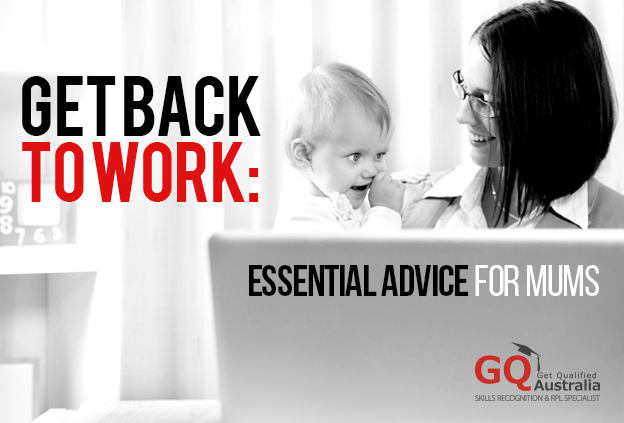
Returning to work after a period of absence is difficult no matter who you are, but especially for stay-at-home mums with young children. There are a number of physical, mental, social and psychological obstacles that stand in the way and all of them must first take into consideration the essential needs of the child to ensure that re-entering the workforce is even a viable option.

In a practical sense, some important decisions have to be made. Who’s going to take care of the children when you‘re out working? Can you ask some friends, family members, or your partner to lend a helping hand? Will you need to make formal childcare arrangements? Can you afford the cost of childcare along with transport expenses to and from work and a new working wardrobe? What happens if your child is sick?

Feelings of guilt and insecurity can also arise for a number of reasons. You may have no choice but go back to work because of your financial situation. Your heart might skip a beat at the mere thought of having to leave your children in the care of another, or missing out on some of those key developmental stages in their lives.

On the other hand, you may be itching to pick up where you left off in your career, but feel out of touch with technology and out of practice using the skills required for the role. You may be worried about the gap in your work history and how this will look to a potential employer.

Maybe you just feel lonely staying at home all the time and want a bit of mental stimulation or social interaction to add some enrichment to your life. You need to get out of the house for a while and do something purely for yourself. You’re sick and tired of feeling invisible in society.

Whatever your situation, lack of confidence can be a powerful inhibitor for mums who wish to return to the workforce. It is a no-win situation because you feel judged on all levels, for relinquishing your duty as a full-time parent, not putting more effort into your career, or simply failing to do anything else with your life.

Unfortunately, it seems like anyone who hasn’t raised a child before neglects to understand everything that is involved with being a good parent. There are no days off, no sick leave, and it costs time, money and a serious amount of energy to care and provide for them properly. The stigma attached to the idea of being defined as just ‘a mother’ is completely unfounded. Raising children is the most important ‘job’ out there. We’re all here because of it, and if no one did it, we’d quickly become extinct.

The trick is to realise that you are actually a lot stronger than you were when you left your job to have children in the first place. You have already tackled one of the most challenging and fundamental tasks known to humanity. Even if nobody recognises your achievement or value (yet), you know the truth, and this is ultimately all that matters. Trust in your abilities and take logical steps to improve your job prospects by taking into account all of your skills, knowledge and experience to date. From there, you can work out a suitable plan of action.

Review Your Skills

An employer’s main concern is deciphering whether you have the ability to do the job at hand or not. As you have been absent from the workforce, it is your prerogative to prove that you are employable right now, both on paper and in person, because you are competing with others who never left the job market and don’t have any parental commitments. For this reason, before you begin creating a resume and applying for jobs you need to ask yourself: Are my skills current, or do I need to retrain in a particular area?

If you are unsure, consult with a professional Skills Recognition specialist. There is a good chance that you can save yourself a lot of unnecessary study time and precious cash spent on needless course fees or repeat training, if your skills are still up-to-date. Get Qualified Australia provides an award-winning service that enables you to obtain a nationally recognised qualification within just 4 weeks through Recognition of Prior Learning (RPL).

RPL is a government endorsed assessment process that examines your existing skill set and prior experience to determine whether you are fully (or partially) competent in a particular field. All you have to do is provide evidence, such as employer references, work samples, or self-made videos that demonstrate your skills in action.

Even if you don’t fulfil all of the requirements for a qualification, which is dependent upon the satisfactory completion of various course units, any gaps in your knowledge could be rectified through online, self-paced study without having to redo the entire course.

It is well worth taking a free skills review online either way to see what options are available to you. It only takes a couple of minutes and there is no obligation to undergo an RPL assessment if you don’t wish to proceed any further. You may as well take advantage of having your skills assessed for free by a qualified RPL expert though. 50% of eligible candidates who apply for RPL with Get Qualified Australia are unaware of their eligibility for a qualification before they take a skills review.

Expand Your Knowledge

A current qualification is something that will always shine on a resume, even if you have been out of work for a while. If you are looking for a new career entirely, undertaking further study is definitely an avenue to explore if you can afford it. Your priorities might have drastically changed since you gave birth and your old career no longer interests you in the same way.

However, being a mother is all about compromise as there is more than your own life to consider, so make sure you set realistic goals. Assess your skills and work out which ones could be transferred to a desirable job for you, then work on expanding your knowledge in the areas that matter most.

Conducting research into your industry is crucial because you haven’t been exposed to what has been happening out there on a daily basis and things might have changed. This applies to the job hunt itself. Reach out to your friends, family and past work colleagues, ask for tips and advice on where to look for jobs, how to write up your resume and practise interviewing techniques.

The more in-the-know you are, the more insight you will have, so that you can be well prepared for what is expected of you by a prospective employer. That way, you can at the very least keep your head held high when you go for an interview with a self-assured and upbeat attitude. There is no need to feel undervalued, or make excuses as to why you took time out to start a family, something which everyone should be entitled to without any negative bias or criticism.

Improve Your Experience

It is wise to analyse different employment options. You may no longer be able to work full-time, or work shifts outside of traditional hours anymore, unless you are willing to hire a live-in nanny, or ask your partner to compromise their employment arrangements. You might want some flexibility and decide that part-time or casual work would suit your situation better. Perhaps you could start your own business and work from home.

Think creatively and you could come up with some winning solutions. If you love working with children, for instance, you could consider doing a short course in Early Childhood Education and Care and become a family day care educator. This would allow you to pick and choose from a range of flexible options, working full-time hours, part-time, after school, or only at weekends, all from the comfort of your own home.

The minimum qualification requirements for working as a centre-based child care worker, or family day care educator, is a Certificate III in Early Childhood Education and Care.

Investigate the full spectrum of opportunities and decide on a short or long-term strategy. Do you need temporary work right away? Or can you afford to pave the way for a successful career that will benefit you more for the long haul, and bypass the frustrating struggle of seeking less than ideal work opportunities?

Securing your first job is tough when you don’t have any current experience, but if you are proactive about it you could opt for some unpaid volunteer work to refresh your knowledge and prove to an employer that you are job ready. Do whatever it takes to start filling that gap in your resume. Hard work always pays off, whether you are studying or getting valuable work experience, it just requires a little patience and determination before you can start benefiting from monetary rewards.

In the end, your final decision will inevitably rest upon why you actually want to re-enter the workforce. If it’s a financial need, then it is recommendable to focus on getting a similar role to your last one if possible, by reviewing your skills, looking at clever ways that you can market them in a professional light to employers, and following the path of least resistance.

If not, then you have more freedom and flexibility at your disposal without that same sense of urgency or immediacy. Use the time you have wisely until you are 100% certain and avoid any unnecessary hiccups on your path back to work. If you have the luxury of waiting for the right time, and a chance to enhance your skills and experience by taking a course or undergoing further training to help you land a better job, don’t let the opportunity pass.

Get out there, give it your best shot, and good luck with the job hunt!


Why interview preparation is a liberating exercise in skills recognition

Why Interview Preparation is a Liberating Exercise in Skills Recognition

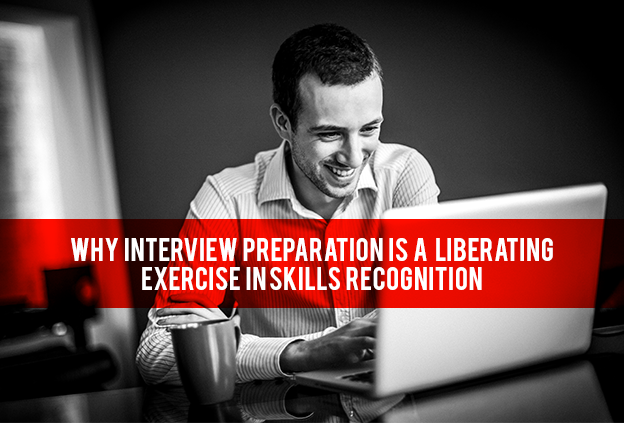
Congratulations, you’ve got a job interview! All that work fine-tuning your resume must have finally paid off. Now you need to sit down and repeat the process all over again, only this time it will be a much deeper self-investigation. Feeling excited?

Don’t fret, it’s easy to get deflated when preparing for an interview. There is a strong inclination to distract away and do something else instead. It could be one of your most hated household tasks, like cleaning out the fridge, scrubbing those pesky bathroom tiles, or tidying up the garage. Anything but sit down and spend time analysing yourself.

Why is this the case when it should be the furthest thing from the truth? You want the job, you’ve got what it takes to get it, what’s the problem? The whole mystery surrounding interviews is such a paradox. How many perfectly suitable candidates turn up in a bundle of nerves, with shaky hands and sweaty palms, despite hours spent memorising answers to every imaginable question?

You don’t need to learn off your answers. You don’t even need to anticipate the exact questions that will be asked. All you have to do is be yourself and demonstrate your suitability for the position on offer. The rest is common sense. When it comes to researching the organisation, or coming up with some questions to ask the interviewer, these details are in your best interest to know, right? Otherwise, you could end up working in a job you despise. You only live once, so better to make wise career choices that complement your beliefs, ethics, personality and skill-set.

When you are preparing for your next interview, use it to your advantage. Take the golden opportunity to get to know yourself and recognise all your career achievements.

An interview is essentially an encounter with a complete stranger and first impressions are everything. This doesn’t mean your knees should start trembling at the mere thought of it. The more comfortable you are in your own skin, the more confident you will come across to a person who knows nothing about you. If you can’t identify what you’re good at, how is an interviewer supposed to surmise where your specialties lie? Be prepared for common interview questions, such as “tell me a little bit about yourself…” and “what are your strengths and weaknesses?” These types of questions serve an important purpose, because they cut to the chase and allow a stranger to learn desirable things about you in a really short space of time.

Don’t even bother going down the fear route. You wouldn’t have got this far if you didn’t believe you could do it. Let your skills shine. Take a sheet of paper and write down five ways that you can contribute to the job role in order of relevance. Refresh and reflect on your own prior learning. One of the most effective interviewing techniques out there is to elicit real-world examples that prove the existence of core competencies. So what comes with the territory in this job based on your work history? It could be the ability to cope under pressure, multi-task, solve problems or manage a large workload. Imagine you were interviewing yourself for this position, what details would you make a point of finding out? If you can provide enough solid evidence, supplemented with glowing employer references, useful qualifications and samples of your work, the job is surely in the bag.

The job application process is actually pretty similar to a simple RPL (Recognition of Prior Learning) assessment. It is a chance to gain official acknowledgement for your existing abilities, previous work experience and determine your eligibility for a job role or, in the case of RPL, a nationally recognised qualification.

Step 1: Skills review
The first step is to assess your overall competencies, match them to a suitable job vacancy, and then register your interest in working for a particular organisation by sending over your resume to the relevant contact person. In order to receive an accredited qualification with RPL, you will take a free skills review online by filling in a few brief details about yourself and the certificate or diploma you wish to obtain.

Step 2: Get started
If you seem like a good fit, the employer will contact you for an interview. Similarly, an experienced skills assessor will ask you to apply for a course and get started with an RPL assessment. This is your cue to conduct an in-depth skills inventory, think about some real-life examples of your skills-in-action and gather as much concrete evidence as possible to support your application.

Step 3: Submit evidence
An interviewer will want to fulfil essential criteria that are required to satisfy the demands of the job description. This involves taking a look at all of the accompanying evidence, such as your resume, employer references, work samples, certificates, awards, qualifications, etc. An RPL specialist follows the exact same procedure by ticking off a checklist of course units and modules to make sure you have enough experience in certain areas.

Step 4: Evidence review
The interviewer or skills assessor will then carefully review all of the evidence.

Step 5: Final decision
The skills recognition process is complete once a decision has been made as to whether you made the cut. If you have met all the requirements, you will be issued with a job offer based on your interview performance, or a qualification from a Registered Training Organisation (RTO) as a result of your RPL assessment. If you haven’t supplied enough satisfactory evidence to support your claim for a qualification through RPL, at least you will have an opportunity to complete gap training, so that you can still qualify. If you don’t receive any feedback from your job interview, it is good practice to ask why you weren’t deemed eligible. That way, you can work on improving those weaker points for next time.

Less stress, more success is a good motto to consider before you start biting your nails at the thought of an upcoming job interview. The process is actually really straightforward and stress-free if you allow it to be. Try and imagine it more as an exercise in self-empowerment, rather than a high pressure situation in which the interviewer holds the magic key to your destiny. If you don’t get the job, it probably wasn’t right for you anyway, so pick yourself up, expel any negative thoughts and never stop believing in yourself. There will always be a second chance.

5 Things You Need To Know When Starting Your Own Business

5 Things You Need To Know When Starting Your Own Business

“The value of an idea lies in the using of it.” (Thomas Edison, Co-Founder of General Electric)

Are you thinking about starting up your own business? Remember, it is one thing being able to come up with a good business idea. It’s another kettle of fish entirely knowing how to put it into action. Without the right planning and preparation, your company is doomed from the start. This is why so many new businesses fail within the first couple of years. The true secret to business success lies in the effective delivery of your product or service to the target consumer. It’s all in the execution.

Let’s face it, there are millions of products out there that nobody really needs, yet they sell like hot cakes. Obviously, the customer feels convinced enough to reach for their wallet, so what’s the big secret? At the same time, there are just as many winning ideas that never receive any recognition. Why does nobody stand up and take notice? Here are some tips to consider if you want to run a successful business.

TIP #1 – Create a business plan

Amazingly, there are a staggering amount of start-ups operating without a viable business plan. It is imperative to test the feasibility of your idea, conduct market research and set realistic business goals before you even dream of making steps to start your own company. You can save yourself an awful lot of time, money, effort and heartache in the long run.

A business plan is an essential blueprint. It measures success indicators against potential obstacles that could crop up along the way. It takes into account your budget and how you can effectively manage your capital. It allows you to prepare an appropriate marketing strategy, figure out the type of organisation structure that will best suit your needs and what the foreseeable future holds for your company. A business plan also gives you an opportunity to assess your own skills: What do you bring to the table? Where do you lack expertise? Who do you need to hire?

Finally, it is very useful if you are looking for outside investment, as investors will want to accumulate as much information as possible to make sure it’s worth the risk. Investing in a start-up is always a gamble, so an experienced investor will always want to trust that you are a good bet.

Visit www.business.gov.au for helpful tips on writing up a business plan, along with free downloadable templates and a handy business planning tablet app to guide you through the whole process.

TIP #2 – Consult a financial adviser

There is no point whatsoever in starting up a business, if you can’t afford it. Poor financial management is the number one cause of business failure. Adequate start-up capital is an absolute must, so it is highly advisable to seek professional advice to double check you have enough funds to carry out your intended business proposal.

A financial adviser can recommend the best financial strategy for you based on your budget, by pointing out any unnecessary outgoings and setting up a savings plan to help maximise your profit.

TIP #3 – Get qualified

The best way to succeed in business is to understand how it works from the inside out. If you wish to open up a hairdressing salon, or a massage parlour, it will certainly help if you are a certified masseuse or hairdresser to begin with.

Running an effective business also requires sharp insight into the day-to-day running of a company. Anyone who has watched Gordon Ramsey’s Kitchen Nightmares will understand just how crucial it is to ensure your product or service is of an outstanding quality and that it is delivered to the customer in the best way possible. There are plenty of business owners out there who don’t have a clue what they are doing. At best, they are losing valuable revenue, but in most cases they are on a sinking ship that has no hope of resurfacing. If you are going to do something, do it right, or else what’s the point.

Know your strengths and weaknesses, what you can and can’t do. Use the skills that you have, but develop the ones that you don’t, or else hire people with those skills.

If you don’t have a background in business, it is strongly recommended to get a Diploma of Business Administration. This will teach you the basics that every entrepreneur needs to know for effective management of finances, accounts, payroll, staff, general administration, IT, customer service, recordkeeping and establishing workplace policy.

On the flip side, if you feel confident enough to run a business and have previously worked in an administrative capacity without a qualification, it certainly won’t hurt to pick one up through RPL (Recognition of Prior Learning) at a fraction of the traditional course cost. In fact, you will be taken a lot more seriously in the business world if your skills and experience are backed up with recognisable credentials that prove you have what it takes.

Visit www.gqaustralia.com.au for a free skills assessment to see what business qualifications you may be entitled to through your existing work experience.

TIP #4 – Know your niche

Once you have conducted some preliminary research on your target market and carved out a space that satisfies enough demand, please be warned that this is only the first step. You need to know your niche like the back of your hand if you want to be successful. This means keeping a close eye on your competitors at all times, because they can easily swoop in and offer something better if you are not careful, particularly if you are just starting out with limited capital.

Think about it, if you were a large corporate entity and came across a small company offering something else that you do not currently provide, wouldn’t you try to steal the idea and assimilate it into your own business as a bonus extra? It happens all the time, so be wary and stay up-to-date with what’s happening in your industry.

TIP #5 – Build a website and social media outlets

Although the word-of-mouth method of advertising still reigns supreme in many cases, a successful business is nothing without a good website in the digital age. Unless you know how to build one yourself, it’s best to hire a professional web designer and copywriter for optimum results. If you have accurately researched your target market and competition, you should already be well versed in the type of dialogue to use when speaking with your customers. Anything further that you wish to find out can be voiced directly to them through your website, blog and social media channels as you see fit.

Investing in an experienced marketing manager to monitor your site and social media could be one of the best long-term decisions you make. Don’t underestimate their value, especially when it comes to analysing your web traffic and utilising tools, such as Google Analytics to constantly improve your service, make it more customer-friendly and introduce an enticing assortment of calls-to-action tailored toward different demographics. It is also sensible to optimise your site for mobile, since smartphones and tablets are forecast to overtake PCs for internet use in the near future.

So the real question is do you want to be a big fish in a small pond, or swimming with the sharks? Either way, the secret to business success lies in the execution of a central idea that will attract enough consumer attention. This takes a massive amount of legwork before you have the capacity to hit the ground running, plus savvy business skills and a wealth of industry knowledge. In fact, once your business really takes off, the learning never really stops, so be mentally prepared for the road ahead. Stepping out on your own takes courage, stamina and endurance if you want to succeed for the long haul. That being said, if you have the right attitude and adopt an informed approach from the outset, the deck will be much more stacked in your favour.

Find Your Perfect Career Match

Find Your Perfect Career Match

Are you in love with your career? Take our career quiz and discover your perfect career match. Your dream job could be waiting just around the corner. The key to success lies in following the right career path for your skills, passion and personality. Get qualified the quick and easy way with RPL!

The Social Media Resume in 2015

The Social Media Resume in 2015: LinkedIn and The Future of Mobile Recruitment

Social media statistics are booming worldwide. In Australia, over half of the population used Facebook and YouTube in January alone, with approximately 3 million active LinkedIn and Twitter users. These figures don’t go unnoticed by big and small businesses as social media continues to revolutionise the commercial sphere in a multitude of ways. For one thing, it is transforming the manner in which recruitment operates, particularly since the advent of mobile apps. Mobile recruitment is predicted to be the standard method by which job applications will be conducted in the not so distant future.

Although it has been suggested that most Australians are still looking for jobs on their desktop, an increasing number are using smartphones to conduct job searches, which allows for much greater convenience, scope and accessibility to the job market. People can search whenever they like, wherever they like, whether it is on the train, during lunch breaks, at the beach, or waiting for a flight. Mobile devices are radically opening up the market, not only for passive job seekers who are willing to explore better work opportunities, but also for anyone who doesn’t own a home computer.

At the click of a button, job seekers already have the ability to apply for positions straight from their mobiles. SEEK and CareerOne both offer a quick and easy way to conduct numerous job applications by creating a profile and uploading a resume, which could easily be stored on your smartphone. You can even sign up to receive notifications of specific job types in certain locations to keep you updated of any new positions on a daily basis.

However, many are beginning to see the value of bypassing these career ad sites altogether, and utilising a more direct approach with their own social media channels. It seems that the medium has truly become the message in the millennial age as more and more personal profiles are being transformed into inventive self-marketing platforms.

LinkedIn remains the dominant favourite for recruiters and job seekers, followed by Facebook, which makes setting the appropriate privacy level on every post you make even more crucial in 2015.

The power of social media to shape, influence and ultimately transform our opinions also means that thankfully it is no longer such an employer-centric market. The authority is shifting and the good news is that it’s falling into our hands. Employers are spending a lot more on marketing and social branding strategies not only to impress customers, but with a view to attracting more potential employees in the short and long term. Companies are looking at our profiles and getting to know our likes and dislikes, but they are also paying attention to what similar businesses are doing in the social sphere. Competition is really heating up over who is perceived as the best company to work for, because it has been proven that brand representation has a direct impact on the number of available candidates for hire. It is now up to the employer to build a relationship with us well in advance, before we even consider applying for a position.

So, what’s the bad news?

Now more than ever, we need to smarten up, expand, update and continuously refine our social media accounts if we want to stand out and get noticed by a recruiter. The days of handing out printed resumes are rapidly declining and professional networks, such as LinkedIn, are instrumental catalysts in bringing about a new era of recruitment that is optimised for both employer and employee. It is up to us to use this to our advantage while the ball is still in our court, because we are not just competing with everyone in our locality, but a global community of users in each industry.

Recruiters in turn have access to a global pool of potential candidates, which they can narrow down by targeting specific demographics and keywords in order to find the ideal applicant for each individual job role. The multinational software company, Red Hat, for instance, is the leading world provider of open source solutions and relies strictly on data analytics to recruit the top candidates in the field. According to L.J. Brock, the vice president of Global Talent and People Infrastructure at Red Hat, candidates are ranked by their proven expertise and market demand, which together formulates an overall skills rating out of 100. This drastically improves the process of talent acquisition by making it faster and easier to source high-quality candidates.

The traditional resume, albeit still widely used, could soon be discarded forever, much like the telephone replaced the telegraph in favour of a more personal, instantaneous mode of communication. Social media has taken the idea to a whole new level, in which the generic document is but a small piece of a much bigger and dynamic picture.

Pros of the social media resume vs the traditional resume

Visibility – If you have an active social media account, you are visible 24/7. Potential recruiters can find you at all times, so you have already expanded your reach far more than you would with a traditional resume, which involves manually sending out each copy yourself. This can often be a laborious, one-sided process that doesn’t end up bearing any fruit.

Convenience – You can apply for jobs at the tap of a button through LinkedIn, using your professional profile as a resume. There is also an option to upload a cover letter or a traditional resume if you prefer.

Faster application – The job application process is faster and easier, particularly if you are looking for a specific job role, in which case you can make numerous applications in just a few clicks on LinkedIn.

Improved job search – On Facebook, Twitter and LinkedIn you can like or follow companies that you are interested in working for and keep up-to-date with news, current events and any new job openings to help improve your job search. LinkedIn will recommend suggestions for you based on the skills, experience and relevant keywords listed on your profile, along with any previous job searches that you have made. You can even fill in preferential criteria to narrow down your search, by selecting an experience level, location, company size and industry. Job recommendations can thus be based on your own special preferences and modified at any time. Better yet, with LinkedIn Premium you can opt to become a featured applicant and move straight to the top of lists commonly used by recruiters to source potential candidates.

Improved appearance and layout – Social media is highly visual, which means that you can present your resume with an appealing layout that can be arranged in a number of ways, depending on if you want to highlight your skills, experience, or both. Add appropriate images, videos, publications, projects and portfolio links to create many layers of intrigue.

Interactivity – Emailing a prospective employer with an attached resume usually requires a level of formality that isn’t always necessary. In social media, instant messaging personalises the communication right from the start. The ability to freely comment on each other’s work also helps build a mutually-supportive relationship that radically differs from the formulaic responses typically found in traditional expressions of interest. Moreover, you can always expand your network over time and establish valuable connections, which could open up new job opportunities that you wouldn’t have discovered otherwise.

Recommendations and endorsements – In a traditional resume, it is common practice to submit a couple of references with your application. Another wonderful thing about LinkedIn is that you can ask for recommendations and skills endorsements from current and previous employers, work colleagues and clients if they are one of your connections. These are publicly displayed on your profile at any time for a potential recruiter to see without ever having to request a reference.

Cons of the social media resume vs. the traditional resume

Visibility – The fact that your profile is publicly accessible means that you have to be extra vigilant about what you post and who you connect with. Think of the social media resume as a living organism. Unless you have your privacy levels adjusted correctly, your achievements, failures or embarrassing moments may be on record for everyone to see. Poor grammar, design and sloppy effort in making your resume shine won’t be well received either. To make a great first impression, you need to treat it as if it were your traditional resume and then some

Faster application – If you have applied for a range of different job roles, it would still be wise to tailor your profile for each role, which takes time.

Undeveloped mobile technology – Even if you have copies of your resume and a selection of cover letters saved on your smartphone, the potential of mobile technology has yet to be fully realised. Most websites haven’t been optimised for mobile applications.

However, as you can see the pros far outweigh the cons when it comes to the social media resume. Whether you like it or not, it’s already beginning to replace how we market ourselves to employers. In 2015 and beyond, it will likely become common practice. Every day that passes by is another one lost in the social sphere. Make sure you don’t waste a second longer missing out on any potential job opportunities and get your profile(s) up to scratch immediately. Use the LinkedIn resume checklist below and tick each section off as you go.

LinkedIn resume checklist:

1) Profile summary

The profile summary is the equivalent to an opening statement in a traditional resume. If an employer isn’t happy with this first section, you can forget about the rest, because they won’t even bother reading it. Recruiters have to skim through hundreds of applications, so if their interest isn’t sparked within a couple of seconds they will move onto the next potentially viable candidate. Consider the summary as one of the most important aspects of your entire profile. It provides an opportunity to describe your skills, experience and qualifications and demonstrate to the employer how suitable you are for the position. Keep it short and sweet and make sure it’s tailored to the required specifications within the job description.

2) Skills and endorsements

One of the best ways to market your skills on LinkedIn is to list your top skills in order of importance. Don’t list too many, just the ones that are relevant. The more connections you have, the more likely you will get endorsements, particularly if you reach out personally and just ask. Adding your skills also enables LinkedIn to suggest jobs that require similar aptitudes, thereby increasing the number of available job vacancies without having to search for them yourself.

3) Work experience

This is pretty self-explanatory. Name each company you worked for and the period of employment, followed by a brief description of each role. Highlight any skills that you gained on-the-job along with key achievements that contributed significant value, or improved profits for the organisation. Another handy thing about LinkedIn is that if your company is registered in the system, it will automatically find it for you and display the company logo. The logo adds a bit more professionalism to the overall visual layout. If the company is not widely known, then it is helpful to include a brief description of the company itself.

4) Qualifications

Make your qualifications stand out by going into a bit more detail here. Perhaps list what subjects you studied at university, discuss your thesis, add extra-curricular activities and societies, or anything useful that you learned or achieved throughout your course(s). Also, look at other types of qualifications that would be beneficial for your job search. With Recognition of Prior Learning (RPL), for instance, you might already qualify for one or more nationally recognised qualifications without any further study or additional training. All you have to do is provide evidence of your skills in action and any relevant work experience. Get Qualified Australia, the country’s award-winning Skills Recognition and RPL experts, offer more than 500 qualifications from 25 colleges and registered training organisations (RTOs).

5) Awards, certificates, patents, courses and test scores

It doesn’t matter where you learned it, if you have already been officially recognised for your achievements, don’t be shy. Flaunt your talents and gain public exposure for your skills whatever they may be.

6) Memberships and recommendations

Advertise your professional memberships and recommendations. If you aren’t a member of an organisation, there are thousands to choose from on LinkedIn. Have a browse and join some groups related to your industry, it’s a great way to expand your network, get tips, feedback and advice and meet new people.

7) Project, publication and portfolio links (if applicable)

A great way to add striking visual impact to your profile is to supply links to various work projects, published works, or portfolios. You can arrange them strategically in whatever order you like, by date, relevance, theme, etc.

8) Interests and volunteering

Include key interests that would be considered complementary to the job role, or at least wouldn’t cause any controversy with potential employers. Don’t forget to mention any volunteering experience, causes you have donated to, or charity organisations that you support.

9) Contact information

It’s good practice to provide an email address, just in case a recruiter prefers this form of communication. Feel free to link your Twitter account too if it is equally as impressive as your LinkedIn resume.

10) Layout

Arrange the sections in a strategic order. What do you want to advertise most to potential employers? Display the essentials in the top half of the list.
 

How to get the right qualifications without any classroom study

How To Get The Right Qualification Without Any Classroom Study

Choosing the right qualification for your skill set can often seem like a complex mystery that nobody has the capacity to solve. In this day and age, there are thousands of degrees, diplomas and certificates on offer for men and women of all disciplines and distinctions. The choices seem endless.

As if finding the best qualification to advance your career isn’t hard enough, moving in the most logical direction towards achieving it can be just as tricky to decipher. The landscape of traditional learning in a university environment has been dramatically revamped since the introduction of the internet. There are a variety of study alternatives currently available that can be cost-effective, convenient and far less time-consuming, such as distance learning, blended learning, e-learning and Recognition of Prior Learning (RPL).  The final destination might be the same, but the routes taken to get there may differ considerably, from person to person, depending on the needs of their situation.

Nevertheless, it’s still easy to get bamboozled and abandon your career goals entirely, or at the very least, temporarily. After all, Google has its pros and cons. Sometimes you can’t find what you are looking for no matter how hard you try, while on other occasions, your search yields overwhelming results that only adds to the confusion. This can lead to the worst place of all – information overload!

Before you have torn yourself away from that computer screen with impaired vision, a creased brow and a sore back. Before you’ve collapsed into bed and pulled the covers over your head in a state of utter exhaustion and emotional despair, consider this little piece of advice: the most important thing to remember is your end goal. Don’t get distracted from your true purpose.

How?

Firstly, take three deep breaths and relax. You definitely won’t find the right answers if you are like a nervous ball of worry, stress and tension.

Next, go and do something you enjoy. Play your favourite song, read a chapter of a book, watch a movie, anything that makes you happy and gives you a chance to escape for a while.

When you are ready to resume where you left off on your frustrating quest for a qualification, try and adopt a completely different approach. Sometimes if you don’t succeed the first time, you shouldn’t need to bother repeating the same useless exercise over and over again, until you get it right. Practice doesn’t always lead to perfection.

Start thinking outside of the box. What would Sherlock Holmes do, for instance? Ok, so you may not feel like some sort of investigative mastermind, but try and lighten up a little and stop taking yourself too seriously. A simple deductive exercise could be just the solution to help snap you out of your self-induced career paralysis and actually get you back on a better track in a matter of minutes, not hours, days, or weeks.

Look at it this way, if you can become a detached observer on a strictly fact-finding mission you may just discover the necessary clues to crack the case without letting your doubts, emotions, or even Google impede your progress. The only difference is that you are the central subject, so you are actually conducting a self-investigation. It might therefore be useful to put pen to paper and organise the facts in a clear, concise and no-nonsense manner. Finding the right qualification and study option can easily be achieved if you follow a simple, straightforward process.

Step 1: Create a character persona

Get back to basics and write up a brief description of yourself, as if you are a stranger who is about to read it. Break it down by answering some or all of the following questions:

What’s your name?

How old are you?

Where do you live?

Are you married or single?

What are your hobbies?

Where do you work?

What skills and experience do you have?

Do you already possess a qualification?

What is your dream job?

What barriers prevent you from advancing your career?

Here are a couple of sample personas:

1)      Liam Walker is 38 years old. He lives in Sydney. He has a stay-at-home wife called Emily and two young twins, Ruby and Jack, who are just about to start school. He likes playing rugby on the weekends with his friends and watching sport whenever it is on the telly.

For the past ten years, he has been working in a warehouse. He initially started out as a picker and packer, but worked his way up through the company to senior management level. He currently manages a large team of warehouse staff and handles all of the logistics, such as managing the flow of orders from pick up to delivery, organising client meetings and liaising with suppliers.

Liam has lots of valuable experience, but no formal qualifications. He wants to move into a similar role with more responsibility and a higher paid salary because he has a mortgage to pay, two cars in the family to finance, a wife to support and two children to put through school. He can’t afford to take time off work and go to university, so what should he do?

2)      Sophie Thompson is 23 years old. She lives in Melbourne with her parents. She is single with no children. Her interests include photography, music and art. She loves to paint in her spare time.

Sophie is working two part-time jobs. She works as a waitress in a café, but she is also an aspiring freelance writer. She has already been published in a couple of well-known magazines, since she graduated with a BA in English a couple of years ago. However, she is unable to secure enough clients to make a decent living and finds it difficult to find full-time work as a feature writer.

Most of the job vacancies she is interested in are looking for copywriters as these positions seem to offer a good salary. However, they usually advertise for somebody with a background in digital marketing, or require specialist knowledge of online content management systems. She could probably take up further study, because she doesn’t have to pay rent at home, but she would prefer if she didn’t have to complete another higher education course. Sophie is also unsure about whether to undertake additional training in marketing or IT. What are the next steps for Sophie?

Step 2: Deduce the right conclusions

This step involves a close reading over your character persona in combination with some targeted online research. The type of qualification and study route you decide on must take into account how helpful and feasible it will be for career advancement in your particular situation. Hopefully, it should seem much simpler now that you have all of the facts in order.

Liam’s conclusion: In the case of Liam Walker, a diploma-level qualification in management will enable him to land a better senior managerial position in another company, particularly with the previous experience that he has attained at the warehouse. Even if he could afford to go to university, there really wouldn’t be much point, because he has already developed all or most of the required skills for his desired role.

It therefore makes the most logical sense for him to try and qualify through a quick and easy RPL (Recognition of Prior Learning) assessment. RPL converts skills and on-the-job experience into nationally recognised qualifications in just 4 weeks without any classroom study. That way, Liam wouldn’t need to take any time off work, or spend hefty fees on extra tuition.

The first step for Liam would be to take a free skills review online with a leading RPL specialist, such as Get Qualified Australia.

From there, he will either be deemed eligible to receive a diploma qualification, or he can gain credit exemption from one or more of the units specified within the diploma course. Any remaining gaps in his training could be filled in his own time, at his own pace, through a convenient e-learning portal.

Sophie’s conclusion: In the case of Sophie Thompson, a diploma-level qualification in digital marketing will provide her with the necessary skills to secure a job as a copywriter. Given that she has a highly visual and creative nature, marketing would likely be a better fit for her talents than learning advanced computer skills. Plus, there will be elements of website design and cross-platform development within any digital marketing course anyway. It would also complement her existing skills, experience and qualifications, by making her more employable in all fields of writing. She might even learn how to market herself better and make freelancing a viable career possibility that could be achieved much sooner than she anticipates.

Sophie could complete a full-time diploma course at a registered college or training organisation, or she could get her qualification through part-time blended learning at a much lesser cost. This way, she could still keep her waitressing job and pursue any writing opportunities that come along in the meantime. Blended learning for this type of qualification generally comprises of online study, live webinars and optional face-to-face tutoring.

The first step for Sophie would be to sign up for a course at a college of her choice.

Ready to take the next steps in your career?

The process of selecting the right qualification for your skills need not be as complicated as you have led yourself to believe. In fact, simplicity is key.

All it requires is a bit of common sense and an objective viewpoint to identify the obstacles in your way and explore the range of appropriate study solutions, many of which no longer require years of university training.

You see, it’s rather elementary, actually.