Category Archives: Career Development

RPL and Skills Recognition can be the solution towards career development. They will help individuals advance in their careers by acquiring the qualification needed to move to the next career stage

Craziest-Job-Interview-Questions-2

Craziest Job Interview Questions

In a fight who would win, batman or spiderman?

Describe the color yellow to someone who is blind.

How many people flew out of Chicago last year?

Who’s your favorite Disney Princess?

Ever been asked an odd question during your interview that has sent your brows raising, your eyes twitching and your mind boggling? Here is a collection of some the craziest job interview questions to be asked in the history of, well, ever! How would you have answered?

“What do you think of lava lamps? And ‘Dilbert’?”
Mike Mozart/flickr
Asked by Boeing for an engineer position.

Tell me a story.
Celgene for corporate communications position

What kind of tree would you be?
Cisco for Senior Technical Writer position

What will you hate about this job?
Medtronic for Diabetes Therapy Association position

Are you a hunter or a gatherer?
Dell Account Manager

If you were a box of cereal, what would you be and why?
Bed Bath and Beyond Associate

How does the internet work?
Job as Director at Akamai

What is the color of money?
Am Heart Association

How many calories in a grocery store?
Google UK

What is the wildest thing you’ve done?
MetroBank UK

If you were an inanimate object, what would you be?
Starbucks Canada

If you were shrunk to the size of a pencil and put in a blender, how would you get out?
Goldman Sachs Analyst

How many ridges are there around a quarter?
Deloitte, Project Analyst

Explain to me what has happened in this country during the last 10 years.
Boston Consulting

If you had 5,623 participants in a tournament, how many games would need to be played to determine the winner?
Amazon Manager

“An apple costs 20 cents, an orange costs 40 cents, and a grapefruit costs 60 cents, how much is a pear?”
Asked at Epic Systems, Project Manager position.

“There are three boxes. One contains only apples, one contains only oranges, and one contains both apples and oranges. The boxes have been incorrectly labeled such that no label identifies the actual contents of the box it labels. Opening just one box, and without looking in the box, you take out one piece of fruit. By looking at the fruit, how can you immediately label all of the boxes correctly?”
Asked at Apple, Software QA Engineer position.

“How many traffic lights in Manhattan?”

Asked at Argus Information & Advisory Services, Analyst position.

“You are in a dark room with no light. You need matching socks for your interview and you have 19 grey socks and 25 black socks. What are the chances you will get a matching pair?”
Asked at Eze Castle, Quality Assurance position

“What do wood and alcohol have in common?”
Asked at Guardsmark, Staff Writer position

“How do you weigh an elephant without using a weigh machine?”
Asked at IBM, Software Engineer position

“You have 8 pennies. 7 weigh the same, one weighs less. You also have a judges scale. Find the one that weighs less in less than 3 steps.”
Asked at Intel, Systems Validation Engineer position.

“Why do you think only a small percentage of the population makes over $150K?”

Asked at New York Life, Sales Agent position

“You are in charge of 20 people. Organise them to figure out how many bicycles were sold in your area last year.”
Asked at Schlumberger, Field Engineer position.

Have a crazy question you’ve been asked during your job interview? Share it with us below. We’d love to hear it.


NewYearNewCareer

New Year, New Career? Know When to Stay and When to Go

Jobs are essential in modern economies. A steady paycheck in exchange for work performed is usually how it’s done. That’s all well and good, but what about you? Are you fulfilled? Challenged? Performing to potential? Is your boss a mentor and your workload manageable?

In the 21st century, vertical career ladders have become jungle gyms, with longevity and loyalty measuring up against productivity and profitability. If you’re looking around, exploring your options, it can be a struggle to make a decision on whether to stay put or move on.

If you can’t decide whether to stay or go, think about these statements and whether or not they apply to you. If you can’t claim at least one of them, it is probably a good time to consider switching horses.

I have a satisfying job description and feel I play a vital role in my organisation.

Congratulations! You are among the happy campers out there that should probably stay put until something changes. Still, staying in touch with the world around your industry is a good idea.

Explore what other firms are doing and then learn all you can. It will help you with your present post, and give you a leg up if you decide to make a change. Not so satisfied? Explore why you feel that way. If it is something that you can change by engaging, give it a shot. If not, discretely begin to look around.

I am satisfied with the salary I receive for the work I do.

If you are making a comfortable salary that compares favorably with what others are paid for your position, location, and industry, cheers, mate! If you feel you could be earning more by making a switch, it may be time to dig into some statistics to see where you stand. If it looks like it’s in line, great. If not, think about what the going rate is and consider asking for a raise.

Timing is everything here so do a little research, then schedule your meeting. Remember, you don’t get what you don’t ask for. Be prepared for either answer, or even to negotiate, knowing what is, and isn’t, an acceptable bump.

My boss is a great leader and mentor.

Few people get it 100 percent right all of the time, but if your boss is doing things right most of the time, and you’re learning things along the way, you’ve probably got a position worth keeping. If you feel undervalued, and leadership is not forthcoming or you’re not learning from the experience, it may be in your best interest to explore your options.

A good leader that can help you grow and advance is a jewel. Even if things are difficult, but you’re gaining valuable industry expertise, it may prove worth your while to stick it out for a stretch. Knowledge is power. Get some, then use it wisely.

My workload is about right and I am working to my potential.

If you’re working a regular week, with a time crunch every now and again, and you are challenged to function to your full potential at least some of the time, that’s a good sign. If you’re always putting in overtime hours for a basic salary without a little something extra in your paycheck, and your potential is but a dream while you’re scrambling to just get bases covered, you’re going to burn out.

Heavy workloads are OK once in a while, but if that’s the norm, get thee to the job bank to at least review some alternatives. Always being jammed up, schedule-wise, allows little time for proper planning and creative problem-solving. You deserve better and may want to move on to a more efficient operation.

My organisation is on a solid path for a successful year.

If your job tucks you into an organised structure with some room for growth and creative progress, consider yourself lucky. If there are rumors, secret meetings, and suspicious glances running rampant, without an explanation of what things look like going forward, that’s a sign.

Listen to the industry buzz, ask questions of your managers if it seems appropriate for your industry and position, and talk with suppliers to learn what’s what within your organization’s framework, then decide if you want to be a part of the plan. Always give your boss the opportunity to explain any unsettling talk that is “going around,” as things are often not what they seem. If the answer isn’t satisfactory, put the wheels in motion to tidy up the resume.

Before You Jump …

Even if you found that none of these statements apply to you, don’t despair. Sometimes a simple change of focus can open new doors to a more suitable career, or even polish up a tarnished one. Once you decide whether to stay in the same industry or make a more challenging switch, research the skills, education, and experience you need to make the changes you’re considering, then make your plans so that next time you review your stay/go checklist, you’ll be right where you should be.

BellBoy

From bellboy to CEO: How Adam Wadi found one of Australia’s fastest growing startups

As a child, Adam Wadi dreamed of a career in hospitality, and as a young adult, he made it happen. Becoming a bellboy in Dubai gave him an entrée into the world of five-star hotels. Hard work saw him rise through the ranks to management positions in a variety of first-class locations.

Like many, he saw a career in hospitality as a chance to indulge in a life of freedom and travel. But the truth was being chained to the hotel lobby with long, unsociable hours for low pay. All the best jobs went to those with qualifications.

Adam knew a Masters Degree in hospitality would pave the way to the freedom and lifestyle he craved. Like most people about to start a family, however, he didn’t have the luxury of being able to study full time for the qualification that he would need to make the move into training and education.

Even more frustrating was that half of the units he would have to study (and pay for) dealt in subject matter he knew better than the lecturers; knowledge gained from years working in the trade. It seemed so pointless. ‘Hospitality is my industry,’ Adam says. ‘I knew it backwards’.

Discovering Recognition of Prior Learning (RPL)

Luckily for Adam, he found a mentor who introduced him to the concept of Recognition of Prior Learning, or RPL. Together they navigated the university’s requirements to prove his expertise and gain exemptions for some units of study. Adam was credited for two introductory units. The saving of $5000 and shortening his course by six months gave him the incentive to enrol and eventually achieve his Masters.

‘If it wasn’t for that person showing me how to RPL myself through a qualification that I needed to move to the vocational education industry, I would never have moved,’ says Adam.

A qualification led to a better life

That qualification opened up a new world for Adam. He got his first training job while still working at a hotel. But after a while he found that his new part-time job paid more than his old full time job, and it was an easy decision to replace his hotel hours with more teaching. He became a full time trainer and assessor.

Adam soon realised that, like him, many people were unaware of RPL and were spending time and money taking classes they believed were necessary to graduate. Even worse were those who never enrolled in a life-changing qualification because they couldn’t afford the investment of time or money.

‘These are smart people, but sometimes they need a little guidance to see their own true potential and the world of options available to them if they hold that piece of paper,’ says Adam. ‘They have no idea that they can turn their skills, knowledge and experience into nationally recognised qualifications.’

That’s when Adam realised there was a gap in the market that he had the knowledge, skills – and the qualification – to fill.

A new start as an entrepreneur

‘I started Get Qualified Australia in my daughter’s room with just a phone and answering machine,’ says Adam. ‘Today I have a hundred employees and we have helped around 10,000 people receive the qualifications they are eligible for’.

He likens what he does to being a coach, guiding clients to unlock their full potential, which gives him immense satisfaction. ‘If it wasn’t for RPL, I would still be working in a hotel,’ Adam says. ‘I just want to give others that same opportunity.’

Get Qualified Australia can help with RPL and gap training to gain a nationally recognised qualification in a speedy and cost-effective way. For more information please contact Get Qualified Australia on 133 775 or visit www.gqaustralia.com.au

LifeOnHold (1)

How to Get a Qualification Without Putting Your Life on Hold

There’s a great new position opening up and it’s squarely in your wheelhouse. You would be perfect for the job, with all the right experience except for one little detail: you don’t have the required qualifications.

Going back to school after spending a few years, or even a few decades in the working world can seem an impossible plan. Responsibilities at work and home claim most of your time. And then there’s the cost. Traditional schooling can take years to complete, demanding tens of thousands of dollars in the process. There is another option.

Through Skills Recognition and Recognition of Prior Learning (RPL), all of your experience can earn you credit, advancing your academic status before you’ve even stepped foot in the classroom. The things you’ve learned on the job, as a volunteer, pursuing a hobby, or simply maintaining a home, can help you leapfrog over the coursework in your chosen field, saving both time and money on your way to the credentials you need to get ahead.

Through skills recognition, the knowledge you’ve gained illustrates your level of expertise, proving what you already know. Whether you’ve learned skills on the job, in the classroom, working on a hobby, or simply making your way through life’s everyday tasks at home, those skills are useful in getting recognition where it’s due: on your resume and academic record.

Scheduling a consultation with a Specialist, and gathering up information about your experience into a portfolio, will allow you to confirm your eligibilty for a qualification at half the time, effort and cost, without the need for any classroom study or relearning what you already know.

Or perhaps you’re uncertain where all of your expertise could lead. A review with an expert could point you in a new, undiscovered direction with exciting job prospects.

The courses you’ve taken at work, that training you’ve received on the job, or the self-driven study you undertook to solve a particular problem are all valuable in the assessment. The hobby you’ve pursued for years, or the work you’ve done managing household budgets, organising family travel, keeping kitchens stocked and organised, and cooking for a crowd can all help you achieve the status of your dreams.

If you’ve been reading the job posts thinking the answer is “no” because of your lack of education, think again. The evaluation of your portfolio is the first step toward getting to “yes,” as the pieces of your expertise come together, forming a solid foundation from which to launch your career’s trajectory. In less time than you think, costing less than you imagine, you’ll have the credentials you need to pursue the kind of job you deserve.

You’ve been in a holding pattern that’s preventing you from advancing in your chosen field for too long, telling yourself “no” because you lack credentials. It’s time to tell yourself “yes,” learning how valuable recognition is for the important things you do every day.

InterviewTips

Winning the Day: Top 10 Interview Tips

Congratulations! They called. They like the skills and qualifications on your resume and have stepped up to schedule your interview. If you’ve moved up a notch or two due to Recognition of Prior Learning (RPL), all the better. That puts you miles ahead of many. Lock in the job by considering a few important points and prepping properly.

1. Do Your Homework: Research the company website and review online information about them, such as SEC filings, and analyst’s reports. Seek out some inside intel by talking with friends, friends of friends, relatives, bloggers, or anyone else that has worked there to understand the culture.

2. Know the Quizmaster: Find out who will be interviewing you and do a little research on them to get a bead on their strengths and focus on their areas of interest. Also, score points for greeting them by name.

3. Tell the truth: Always. If a weakness rears its ugly head, and you know yours better than anyone, plan ahead of time how to turn that negative into a positive by addressing the issue with how you’ve improved performance. Here’s where skills recognition can take a front seat to the “pants on fire” applicant making things up to get the job. Use information from your RPL portfolio to illustrate expertise appropriate to the job.

4. Craft Your Story: Everyone’s got one. Make sure you’ve practiced yours and that is illustrates your experience and parallels the position you seek.

5. Copycat Chat: Match the interviewer’s tone and body language, taking cues from them to fit in.

6. Listen: Really listen, and hard, to what the interviewer is saying, and asking. Then take a moment to think before you respond or speak, considering the best answer. You would be surprised what a difference a few seconds spent organising your thoughts can make.

7. Don’t Ramble: Answer the interviewer’s questions with a clear, concise reply. This is a conversation, not a tell-all, so leave the fine details out of it unless otherwise requested.

8. Ask for the Job: You don’t get what you don’t ask for. State it plainly and politely, emphasising why you’re the right choice.

9. Manners Matter: Shake hands and say thank you at the end of the interview, regardless of how it went.

10. Send a follow-up thank you note: Bonus points for a handwritten note or a nicely typed letter with a signature, on nice paper.

Putting all these tips into practice will really help push your name to the top of the list. Additional rules of etiquette that go a long way are simple.

Know where you’re going and where to park or what bus to take, allowing ample time so you won’t be late. Plan to arrive 30 minutes ahead of time, but don’t enter the office or location more than ten minutes in advance. If you’re early, use the time for some preparatory review.

Choose a clean, well-maintained, appropriately-styled look for the job. If you’re in banking or finance, up the crisp and dandy factor a notch. If you’re in tech or advertising, show off a bit of your creativity, but don’t go overboard.

Smile and make eye contact. People like that. It shows sincerity as well as a pleasant demeanor. Nobody likes a grouch, and frowning makes you look old.

Lastly, and this is huge. Turn off your cell phone. Now, go get ’em, tiger!

FastTrack_MBA

Using What You Know: The Fast-Track MBA

You’re a professional. You’ve learned the ropes, done the work, and know your stuff. You’ve got the ambition, the drive, and the skills that move winners forward. What’s missing?

If you just said your MBA, that’s about to change.

Going through a Master of Business Administration (MBA) program can be expensive and time consuming. It’s particularly challenging if you’re busy working, raising a family, or staying current in your field.

Traditionally, MBA programs span two years of coursework and cost tens of thousands of dollars. For many deserving souls, that simply isn’t a feasible option. But, what if there were a way to use what you already know, applying your expertise to a qualification to lighten the load? What if it could add those important letters after your name, quickly and efficiently? It might even earn status to meet requirements, ensure career advancement, and enhance job opportunities, without the financial and calendar pain.

Skills Recognition and Recognition for Prior Learning (RPL) are expertise assessment programs that do just that. They look at your experience and work to speed things up and cut costs. Through an assessment with an RPL specialist, your experience counts and your path to a 12-month MBA is plotted. It’s quick, and it’s easy.

Consider all the ways you’ve learned what you know. In school, your formal pathways provided a standard level of achievement. On the job, you have solved hundreds, perhaps even thousands of problems through innovation and experimentation, and taken training courses that prove your competency. In life, as a volunteer, or just tinkering around with a hobby, you’ve learned lessons no teacher could possibly have delivered so effectively. Gather all that up and you’ve got quite the portfolio.

What you’ve learned in life can be applied toward the qualifications and diplomas of your dreams. Arranging and running meetings, scheduling travel, managing employees, troubleshooting operations, using computers and machinery, creating documents with software, it all adds up to give you credit where it is due.

Arranging a consultation with an RPL Specialist initiates the assessment process, launching your MBA pursuit right into the appropriate level of learning. You won’t have to spend time taking basic level courses covering material that your expertise shows you’ve mastered. That means you won’t have to pay for them, either.

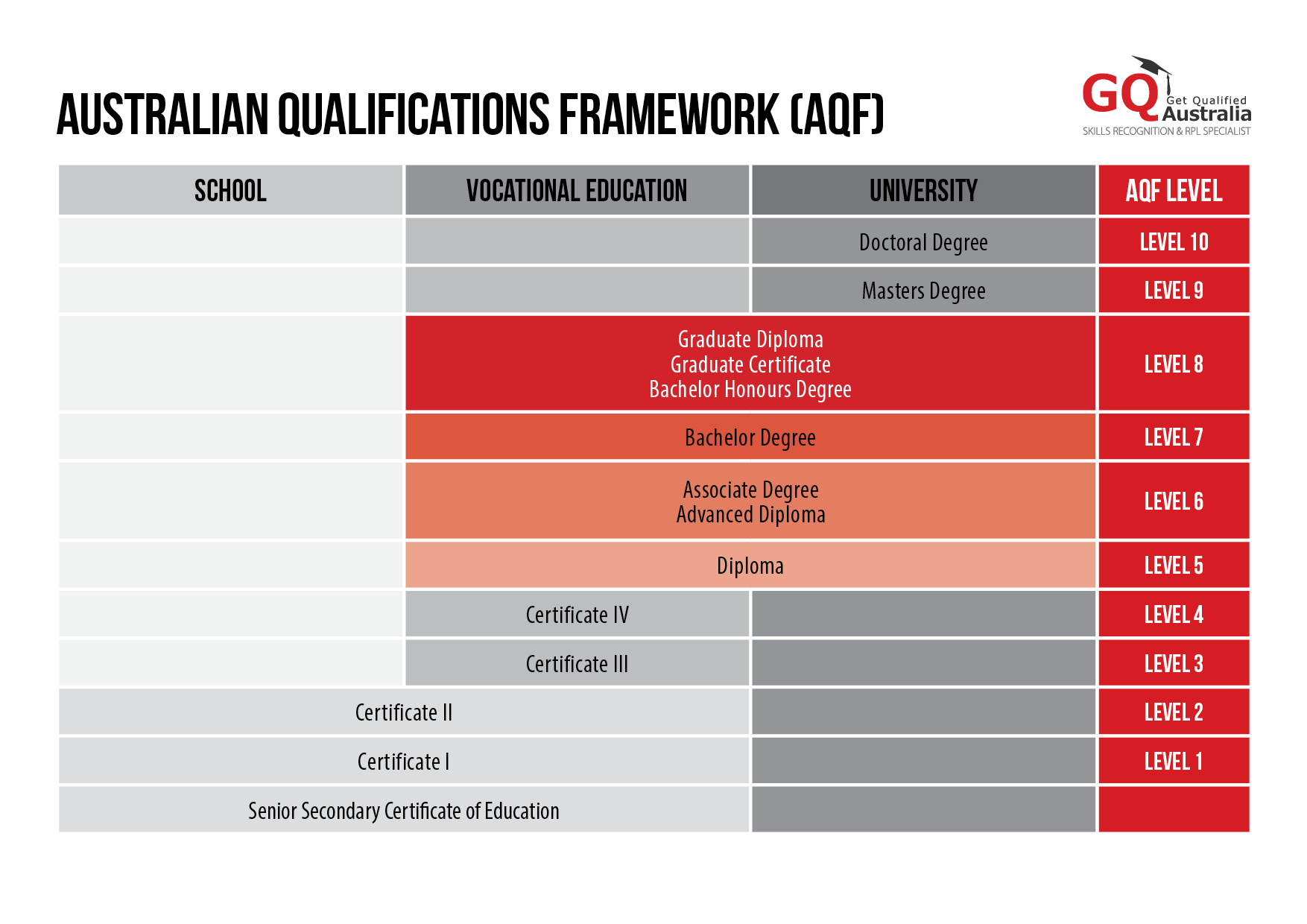
Even if you’ve not yet earned a Level 8 Graduate Diploma, that achievement is often quickly and easily accomplished through Skills Recognition. Once that’s completed, you’ll be able to take on a Level 9 MBA at half the time and cost, making that giant, satisfying leap forward.

Whether you seek a promotion in your current position, hope to apply for a more senior position requiring MBA status, need to fulfill visa or licensing requirements, or simply want to elevate your status, the fast track MBA through Skills Recognition and RPL offers advantages that will get you to your goal faster. Can you think of a single reason not to get started today?

AQF_Breakdown_V2

Get Qualified Australia’s University Pathways through the Australian Qualifications Framework (AQF)

PayRaise

Top Ten Strategies to Win That Pay Rise

You work hard. You pitch in, contributing to your company’s bottom line, giving it your best, all day, every day. No one should expect to get paid more just for showing up, but you’ve been performing well, things are running smoothly, and by golly, you deserve a pay rise. It’s time to ask for one. Hold on a second, however. Asking for a salary increase is probably justified, but that doesn’t mean you’ll automatically get one.

Pay rates and salaries can be difficult for bosses and managers to discuss, especially during uncertain economic times or during very busy seasons. What steps can you take before requesting a bigger number on your paycheck to improve your chances of getting what you ask for?

Here are ten proven strategies to use when requesting a pay rise:

1. Know Where You Stand

Google your industry and job title to see what others in your field are earning as a baseline, fair market comparison. Take your location, your experience, and your industry into consideration. If your salary is on par with the norm, you’d best keep your request modest. If you’re falling behind on the salary scale, it may be a good time request a rise in pay.

2: Consider Your Assets

Everyone has skills. Review yours before making a request. Don’t limit the list to your job title. Include everything that contributes to your overall performance. Special skills that you bring to the job make you more valuable than your title suggests. Completing a free skills review can help highlight your skills and determine your eligibility for Recognition of Prior Learning, supporting your request with skills recognition from things learned in the classroom, on the job, or in everyday life, and earning you a pay bump.

3: Before the Performance Review

Make your request as early as three to four months in advance of scheduled performance reviews. Bosses are generally not receptive to surprise requests, and raises are frequently decided well before the review. Calling attention to your performance prior to budgeting and salary decisions will improve your results.

4: Be Aware of Timing

It’s much easier to grant a pay rise during favorable economic times, especially if you’ve been meeting or exceeding expectations. If the company is in the midst of a big change, or your boss is extremely busy, it may be smart to wait for a more settled time to make your request.

5: Be Realistic

Doubling your salary sounds wonderful. For most employees, however, that’s not realistic. Unless you are engaged in an industry like financial services or computer software, the average increase for most sectors remains between three and four percent per year.

6: Prepare to Negotiate

Getting to yes may take a bit of back and forth discussion. Decide ahead of time what the range of an acceptable increase would be, and how you will respond to offers that fall short.

7: Have A Backup Plan

If the answer to your request is no, remember that it may have nothing to do with performance and everything to do with budgets. When there is simply no possibility of initiating a pay increase, bring up the option of taking extra days off, receiving increased training, or getting perks like parking or health club benefits as possible alternatives.

8: Use Your Most Durable Smile

Even when things don’t go your way, make sure to smile. Thank your boss for listening, and use your most diplomatic voice as you close the discussion. Aggressive or whiny behavior will not change the decision, and may adversely influence future requests.

9: Improve Your Future Chances

When a request for a pay increase must be refused, it can be helpful to ask for guidance. Ask for suggestions and hard performance targets that might change the answer on future requests.

10: Convince Yourself

After making an honest critique of your efforts, you should be armed with the right tools to believe in yourself, convincing the most important person in the room that you deserve a pay rise. Now, you’re really ready. Let’s go!

CHAFTA

(Infographic) ChAFTA: How to Improve your Employment Prospects

Note: Please note that Get Qualified Australia is neither involved in nor endorses the China-Australia Free Trade Agreement. As Australia’s leading Skills Recognition & RPL Specialist, it seeks to improve the employment prospects of Australian workers through skills recognition services and the issuing of Nationally Recognised Qualifications.

The China-Australia Free Trade Agreement (ChAFTA) has caused much controversy since being signed in June 2015, particularly within industries directly affected by the Agreement. However, despite the apparent backlash, it is important to consider whether the Agreement really poses as great a risk to Australian jobs and workplace safety as presumed, or whether there are ways to bypass and limit the potential negative repercussions the Agreement may have on the above factors, by working it to the advantage of Australian workers.

Want to know more about ChAFTA and how to improve your employment prospects? Read more here.

ChAFTA_Agreement_Infographic (4)

CHAFTA

ChAFTA: Facts and How to Improve your Employment Prospects

Note: Please note that Get Qualified Australia is neither involved in nor endorses the China-Australia Free Trade Agreement. As Australia’s leading Skills Recognition & RPL Specialist, it seeks to improve the employment prospects of Australian workers through skills recognition services and the issuing of Nationally Recognised Qualifications.

View the China-Australia Free Trade Agreement Infographic here.

The China-Australia Free Trade Agreement (ChAFTA) has caused much controversy since being signed in June 2015, particularly within industries directly affected by the Agreement. However, despite the apparent backlash, it is important to consider whether the Agreement really poses as great a risk to Australian jobs and workplace safety as presumed, or whether there are ways to bypass and limit the potential negative repercussions the Agreement may have on the above factors, by working it to the advantage of Australian workers.

To grasp this concept better, it is important to first look at the implications of the Agreement.

At the heart of ChAFTA lies the streamlining of relevant skills assessment processes for temporary skilled labour visas, including a reduction of the number of occupations currently subject to mandatory skills assessment.

This means that Chinese workers looking to apply for an Australian Temporary Work (Skilled) 457 visa, will not be subject to mandatory skills assessment for ten prescribed occupations. These occupations include:

Automotive Electrician [321111]

Cabinetmaker [394111]

Carpenter [331212]

Carpenter and Joiner [331211]

Diesel Motor Mechanic [321212]

Electrician (General) [341111]

Electrician (Special Class) [341112]

Joiner [331213]

Motor Mechanic (General) [321211]

Motorcycle Mechanic [321213]

The removal of assessment practices leaves many questions for Australian tradies, predominantly:

– What safety measures will ensure that Aussie workers have access to job opportunities in Australia?
– What safeguards will ensure that safety standards in Australian workplaces are maintained?

In order to be able to answer these questions, one must first ponder the facts.

Fact 1) Shortage of skilled and qualified labour
Under the Agreement, a Chinese company investing more than $150 million in Australian infrastructure projects must use Australian workers unless the company can prove that there are no existing qualified Australian workers to do the job.

This means that Chinese workers may only be considered for job purposes if there is a shortage of skilled and qualified Australian workers for any given task. Even so, the company or investor may only bring in a limited number of qualified overseas workers who possess the specific skill sets required for the job, and only for a limited period of time when suitable local workers cannot be found.

Summary Points:

– Skilled and qualified Australian workers given job priority
– Chinese workers only brought if there are no qualified Australian workers to do the job
– Limited number of qualified overseas workers may be brought in

Fact 2) Skilled and qualified Chinese workforce

In the event that there is a shortage of qualified Australian workers, any foreign employees brought in must possess all the necessary skills and qualifications required to do the job. The Agreement does not modify the existing experience, skill and qualification-based requirements that foreign workers must possess when applying for a temporary skilled visa, but rather only proposes the removal of mandatory skills assessment procedures by Trade Recognition Australia, within the ten listed occupations.

This means that applicants must still demonstrate to the Department of Immigration that they possess the requisite skills and experience to work in the country, by supplying evidence of work history, qualifications and documents which demonstrate their English language skills. Should the candidate insufficiently prove their competency, or if further verification is required, they must undergo an additional skills assessment conducted by a registered training organisation (RTO) approved by Trades Recognition Australia.

Summary:

– ChAFTA does not change required qualification requirements and skill levels of foreign workers
– 457 visa applicants need required skills, qualifications and experience to work safely in Australia, and adhere to all visa requirements
– Further assessment may be conducted to verify skill levels and competency by a TRA-approved RTO

Fact 3) Maintenance of licensing requirements and safety standards

Because Chinese workers are subject to the same qualification and skill-based requirements as Australian workers, and hold the necessitated levels of competency, the Agreement does not change and/or diminish the licensing requirements or safety standards of Australian workplaces. Competent workers equate to competent work, less hazards, and maintenance of safety standards.

Summary:

– Licensing and qualification requirements maintained
– Safety standards maintained

How to sustain your employability in the face of ChAFTA

Because Chinese workers within major infrastructure projects can only secure positions in which there are no skilled and qualified Australian workers to do the job, it is important for each Australian employee to possess the right skill sets and qualifications to achieve consideration for projects, and essentially, keep their jobs.

If you do not have the required qualifications to work in your industry and wish to either achieve recognition for your existing skills and experience or simply expand the fields in which you are currently qualified, you may do so by attaining a Nationally Recognised Qualification. Attaining a qualification doesn’t have to take years, and can often be done within weeks, from the comfort of your own home.

As a credible method of gaining certification, Skills Recognition & RPL allows you to convert your existing skills, knowledge and experience into a qualification by supplying evidence of your competency against the core and electives units of your desired qualification. This means you’ll be attaining formal recognition for what you already know and are proficient in, whilst proving to employers that you are a skilled, qualified and experienced worker with full competency to work in Australian workplaces.

Qualifying our Aussie workforce will ensure that the need for foreign workers is lessened, the Australian workforce is qualified and given priority jobs, and each individual employee achieves the competitive edge required to remain employable in the face of ChAFTA.

Think you’re eligible to convert your skills and experience into a Qualification? Take our Free Skills Review to find out!