
Monthly Archives: April 2015

Why do beauty therapists need career treatment?

Why Do Beauty Therapists Need Career Treatment?

The beauty industry is really hot right now. Almost every week there is a new anti-ageing potion, pore-cleansing peel, acne-fighting formula, skin rejuvenator, body tonic, magic skin serum, hair removal treatment or revolutionary cosmetic being launched that promises to help eradicate those tell-tale wrinkles, stimulate collagen and generally make you look and feel younger.

From injections to fillers, microdermabrasion and laser tech, there is something for everyone these days and it’s no longer a ladies-only club either. Visiting a beauty therapist is becoming much like seeing a doctor or dentist, only without the nervous anticipation that accompanies it, at least after the first time anyway.

Beauty is skin deep but therapy goes beyond the surface

I clearly remember my initial consultation for a course of laser skin treatment. While I was sat in the reception area flicking through a magazine, it took everything in me not to bolt out the door. I felt vain and superficial for making such a big deal out of a few minor imperfections that could easily be covered over with makeup. I knew that others had way worse skin conditions than me, but the damage had already been done, and I’m not talking the physical kind. My emotions were running riot. The “I’m getting old syndrome” had reared its ugly head and I couldn’t take feeling like crap anymore. Something had to give.

Imagine my astonishment when I walked into that consultation and was put completely at ease. It wasn’t like a doctor or dentist proceeding to point out all of the ways I was harming my health with that underlying hint of disapproval.

On the contrary the very opposite was true. The skin specialist at the clinic really knew her stuff, but she didn’t use that against me by waffling on in a patronising rant. She helped me to discover how to take care of myself from the inside out, asking me basic questions about my diet, water intake, exercise regime, sleeping habits and stress levels with a genuinely caring tone in her voice. She didn’t push anything on me whatsoever. “It’s your choice whether you want to proceed”, she said, while explaining the ins and outs of it in an informed, no-pressure manner. I left with a question in mind. I thought “where have you been my whole life?”

Beauty therapists deserve recognition

In hindsight, what astounds me more is just how knowledgeable a beauty therapist can be on health matters, nutrition and the latest advances in the industry, both in practice and theory. Yet many enter the trade with an entry-level certificate and that’s where their formal education ends. Some are even managing their own beauty salon or wellness spa without any further training, but through a process of hard work, perseverance, learning from others and downright dedication to the craft.

Don’t get me wrong, I’m not denying that there are many others still who opt to undertake additional courses of study. Specialised treatments must surely require a licensed certificate in some cases for health and safety reasons alone. But for whatever reason, there are people out there with valuable skills and experience that never got a chance to expand their knowledge in an official capacity.

Do you work in a salon or spa? Get a diploma through RPL without study!

What if I told you that you’re potentially eligible for a nationally recognised qualification without any further study? Recognition of Prior Learning (RPL) offers an alternate route for anybody who wishes to progress in their career.

Whether you’ve acquired your skills through a course of study or training program, at work, in your own time, or a combination of different learning methods, RPL takes all of your previous experience into account to determine if you fulfil the essential criteria required for a qualification issued under the AQF (Australian Qualifications Framework). Learn more about the RPL process here.

Give your career the star treatment

Is it time for a career makeover? A diploma-level qualification is usually the most common type held in the industry, followed by a certificate III/IV. Only a small proportion of beauty therapists undertake a Bachelor degree.

If you currently specialise in offering a comprehensive range of spa and beauty treatments, such as massage, hair removal, cosmetic tattooing, lash and brow treatment, nail technology, aromatherapy, makeup, skin care, and product advice, why not treat your career to a fast-acting Diploma of Beauty Therapy.

Are you a salon owner or manager? Qualify your managerial know-how with a Diploma of Salon Management and get the formal recognition you have earned on your path to self-made success.

With RPL, you can get qualified in weeks at a fraction of the original course cost, once you’ve submitted all of the evidence that will be needed to demonstrate your competency.

So why do beauty therapists need career treatment? Because they deserve it, of course! And a qualification is always useful in today’s world. You can take it with you wherever you go, whether you want to branch out entirely on your own, look for a better job, get paid a higher salary or land a promotion; it benefits the employer, customer and above all, YOU!

Get Qualified Australia are the nation’s award-winning RPL Specialists. Take a 2-3 minute free skills review online today and discover what qualifications you are eligible for.


Are you an older worker? Make your experience count!

Are You an Older Worker? Make Your Experience Count!

“The only source of knowledge is experience.” (Albert Einstein)

It’s time for a change in this country, and it’s going to happen with or without the people’s consent. In a technologically superior mindset, it’s easy to forget the primitive traditions of the past, until there is no choice but to accept that they weren’t all completely wrong to begin with. Some of our oldest customs hit the nail right on the head, and yet somewhere along the way we began hammering from the wrong end.

The forgotten wisdom of the elders

Remember the old precept of ‘respect your elders’. Well, this wasn’t used merely to designate age, but rather it was about ripening, becoming wiser and reaching a point where years of living and learning actually counted for something. The elders were looked up to in the past. They were highly valued members of the human tribe, not because they couldn’t contribute anything more, or were a burden on society, but for the reverse reasons. The elders had so much knowledge to pass down to the younger generations, learned through years and years of proven firsthand experience that they were positioned at the top of the pyramid. Everything flowed down through them.

Unfortunately, today this sentiment feels somewhat hollow. Nearing retirement is no longer as much a cause for celebration, but often more of a downward spiral, where you’re not considered important, trustworthy or reliable in society anymore. Employers put their eggs in the basket of youth, while the older workforce is left to fight over the remaining scraps, which seems terribly unfair, especially for those who genuinely want or need to continue working.

Old age is ‘in’ again

Thankfully though, the table looks set for a drastic turnaround in the not so distant future. Our ageist society, in its absolute failure to acknowledge the valuable expertise held by millions of older Australians, must own up to its foolish naivety. Australia can’t survive without the elders. It needs their help to grow up.

Working well into our 60s will be common practice in decades to come. The karmic scales will finally fall in the favour of a population that is ageing in itself, with less and less young workers around to fill an ever widening gap in the labour market. Not only that, but the economy won’t be able to afford to waste such talent. In fact, it won’t survive without it.

Recognition of Prior Learning in modern times

There’s no point lying about it, money makes the world go round and if you want to earn it, a word of mouth recommendation will only get you so far. Qualifications are one of the major buzzwords of the contemporary age, and if you don’t have them, so long and good luck. It might sound harsh, but just having what it takes isn’t enough anymore. That little piece of paper really helps.

So if you’re one of those wise old owls looking for work, but keep getting turned away because your skills look out of date, maybe it’s time to get the recognition you deserve with a current qualification under your belt.

RPL, or Recognition of Prior Learning, is a modern revision to the traditional conception that wisdom and knowledge should be rewarded and recognised in the public domain. Vouched for by the Australian government, it enables you to reinforce your expertise with a nationally recognised qualification without needing to relearn what you already know in an academic environment.

Normally, you’d need to study a variety of course units over an extended timeframe before you’re qualified, but RPL bypasses this lengthy and costly process, saving time, money and teaching resources that would otherwise be wasted on students if they had previously covered the course material.

Get qualified within weeks!

“Experience is the teacher of all things”, Julius Caesar once famously remarked, which is why RPL offers a brilliant compromise to the dilemma faced by those who have accumulated useful skills throughout their lifetime, but perhaps haven’t had a chance to use them for a while, or maybe they didn’t go through the official channels in order to get them in the first place; they could have been acquired on-the-job instead.

Take a free skills review to assess your eligibility for a qualification through RPL in a matter of weeks without any unnecessary retraining involved. With hundreds of qualifications on offer, from the traditional trade services, such as plumbing, carpentry and construction, to business, finance, IT, retail and hospitality…the choices seem endless.

Whether you desire a complete career change, a new job, a promotion, or simply wish to re-enter the workforce after a period of absence (perhaps you’re just looking for some ideas to make some extra cash), consider RPL as a cost effective, time saving alternative.

After all, as a mature age worker, you didn’t get to where you are today only to start at the very beginning again. Make your experience count for something!

How to Use RPL for a Lifetime of Adventure

How to Use RPL for a Lifetime of Adventure

Are you an adrenaline junky looking for your next fix? Are you a nature enthusiast skilled in the art of bushcraft and survival techniques? Do you love participating in adventure sports like surfing, abseiling, mountain climbing, trail riding, white water rafting, snowboarding or skiing?

Let me guess, are you an outdoor instructor? If not, then perhaps you should consider it as a full-time career option. I mean, if you had a choice between working outside in the fresh air doing something that you enjoy, or being chained to a desk all day, then it’s a no brainer, right?

RPL is perfect for the outdoorsy type. Whether you’ve been working in the outdoor education industry for a while, or have used your spare time to develop skills and knowledge independently, you could be cashing in on your experience by gaining a nationally recognised qualification without any classroom study.

What is RPL?

Recognition of Prior Learning (RPL) is an alternative pathway to qualifying in a particular discipline. Endorsed by the Australian government, it allows you to convert what you have previously learned from formal education, training courses, work experience and informal study, such as volunteer work and self-led learning, into an accredited qualification issued by an Australian Registered Training Organisation (RTO).

RPL and Gap Training

RPL can also be used to identify any gaps in knowledge, which could be filled through an online e-learning portal at your own pace, in your own time, or directly through an RTO. The arrangement of gap training depends on what type of training would be needed in the first place and whether it’s practical or theory-based.

For instance, one of the essential units that must be completed for a Certificate II, III and IV in Outdoor Recreation is the provision of first aid. This would be something that couldn’t really be tested satisfactorily in a virtual environment. In a life or death situation, you certainly won’t want to risk not having had any prior hands-on practice in first aid procedures. Wherever possible though, online self-paced study will be recommended if and when it’s required.

RPL and Credit Exemptions

In addition, credit exemptions on higher degree courses may be achieved via RPL. If you get a Diploma of Outdoor Recreation through RPL, for example, you may then be eligible for an exemption of up to one year from a Bachelor of Outdoor and Environmental Education course that would normally take three years to finish.

How does RPL work?

The RPL process is very simple, especially with Get Qualified Australia, the nation’s leading RPL experts.

1. Free Skills Review

Once you’ve conducted a 2-3 minute free skills review online, an RPL Specialist will be in touch to discuss your eligibility for one or more qualifications.

2. Eligibility

If you’re deemed eligible, you can decide which qualification you want to pursue. You’ll then be teamed up with an appropriate RPL Assessor who will have a high level of expertise and industry specific knowledge in your chosen field, as well as a real insight into the expected learning outcomes and criteria that need to be fulfilled.

3. Submit Evidence

Every qualification on offer through the Australian Qualifications Framework (AQF) has a selection of non-elective (core) course units that must be completed. Usually, a fixed number of optional electives must be chosen too and these determine what areas you intend to specialise in.

On the Certificate IV course in Outdoor Education, 31 units have to be achieved to qualify, including 15 core units and 16 electives. The elective units consist of activities like:

abseiling, bushwalking, canoeing, canyoning, caving, climbing, cycle touring, fishing, four wheel driving, horse handling, horse riding, kayaking, mountain biking, rafting, scuba diving, skiing, snowboarding, surfing, snorkelling, trail bike riding, yachting, vertical rescue, white water rescue, tour guiding, tour management, natural resource planning, interpretation of native plant and animal species and interpretation of landscapes and marine environments.

Because RPL is an evidence-based assessment, rather than involving active study, course participation and end of term exams, it is imperative that you can demonstrate your prior learning. In other words, you’ll have to be able to prove you already possess all of the required skills and competencies, so that you can gain an exemption from having to actually take the course. The RPL Assessor will work with you to help gather all of the supporting documentation that may be necessary to tick off all of those prescribed units. This could include employer references, self-made videos of your skills in action, qualifications, training certificates, etc.

4. Evidence Assessment

The RPL Assessor will take care of all the formalities so that your evidence is compiled in a way that satisfies the demands for each unit in order to get a qualification from an RTO.

5. Get Qualified

If you don’t need gap training, a nationally recognised qualification is yours and will be issued within a few weeks!

Hundreds of Qualifications from RTOs across Australia, what will YOU choose?

Don’t delay, start the process today and you could be qualified in a very short time. If you live and breathe adventure, why not make a permanent career out of it?

Qualifications via RPL include the:

Certificate II in Outdoor Recreation

Become a supervised team member of a camp, recreation centre or facility working as an outdoor activity assistant, where you could be traversing a wide range of terrains and using various types of equipment.

Certificate III in Outdoor Recreation

Already got your certificate II and previous industry experience? Get a qualification upgrade and put your technical skills to good use by working as an outdoor adventure guide in a controlled environment, either on your own, or as part of a team.

Certificate IV in Outdoor Recreation

Have you already got a certificate III along with proven work experience? Become an outdoor guide or instructor and you’ll have an opportunity to impart some of your wisdom to the next generation of thrill seekers.

Diploma of Outdoor Recreation

Do you have a certificate IV, a current first aid certificate and experience working in outdoor recreation? This diploma would enable you to work as a facilitator, operations manager, outdoor guide, instructor or program manager, where you could be designing and implementing exciting outdoor adventure courses, programs and activities.

If you want to learn more about RPL, click here.

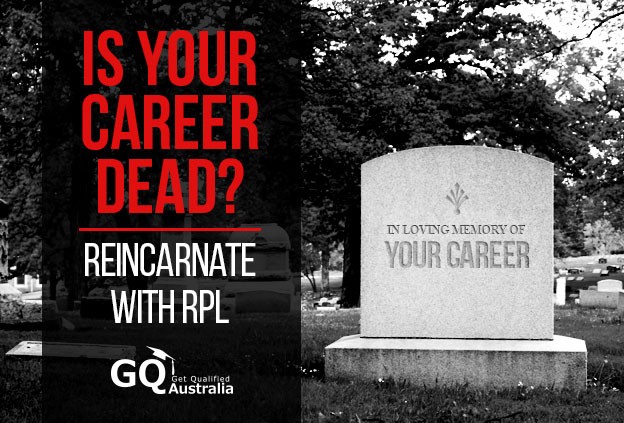
Is Your Career Dead? Reincarnate with RPL

Is Your Career Dead? Reincarnate With RPL

Are you filled with dread at the mere thought of work? Do you repeatedly hit the snooze button when you wake up and leave it until the last possible minute before you drag yourself out of bed? Have you reached your peak of job fitness and feel unable to contribute anything more to the role? Perhaps you despise your boss, or simply aren’t appreciated by the company where you work? Or does it go even deeper than that? Is it the industry itself that no longer excites you?

If you answered ‘yes’ to any of the above, it’s a sure sign that your career has gone way past its expiry date and a change is long overdue. Use any remaining willpower you have left to make a clean break, or else risk becoming a career zombie, where you just go through the motions each day without any real degree of consciousness, while work keeps taking nasty chunks out of you until there’s almost nothing left of your sanity.

Please don’t let it get that far. Buy a copy of Kaleel Jamison’s The Nibble Theory and the Kernel of Power and you’ll understand why this situation is getting out of hand and it’s up to you to preserve your strength for the good stuff. We all have something magical to offer to society and ourselves. Don’t become a ghost in the machine.

And remember you’re not alone either. Business Insider Australia released 15 Seriously Disturbing Facts About Your Job a few years ago, and at the top of the list of revelations was a whopping 80% of people feel unhappy with their current job. Next in line was a crushing reminder that we spend 90,000 hours on average working. Not great if it’s spent in a job you hate then, is it?

Let’s not wallow in misery together and try to stay optimistic. Career changes are common for people of all ages, it’s a matter of choosing the next step in your life path, which involves an empowering process of self-evaluation.

Ask yourself, what do I really want out of life? What am I good at? What makes my heart beat with joy? What have I learnt throughout my career so far that could be useful? Can I turn my favourite hobby or passion into a viable career instead? Could I potentially start my own business, become a consultant, freelancer, coach or mentor? Or do I wish to move into a new profession entirely?

Albert Schweitzer sums up the big lie that many of us are sold when it comes to equating career success with personal fulfilment.

“Success is not the key to happiness. Happiness is the key to success. If you love what you are doing, you will be successful.”

Bring your career back to life through RPL

Have you ever come across the concept of Recognition of Prior Learning (RPL) before? RPL examines everything that you have to contribute towards your chosen career path, regardless of how, when and where you learned it, including life experience, work experience, formal qualifications, partially completed courses, volunteering and self-study. It allows you to gain official recognition for your skill-set by issuing a nationally recognised qualification without any unnecessary classroom time. Better yet, a qualification can be achieved within weeks as opposed to months (or years) spent studying at university. Now wouldn’t that be a nice head start for anyone considering a career change?

Changing careers can be costly when you’re starting completely from scratch, but what many people fail to realise is that often they’ve accumulated transferable skills that could be applied across a wide range of different industries, businesses and work environments. A banker, for instance, may have already learned some of the skills required to be an accountant. An RPL assessment could help identify knowledge gaps that may be filled without needing to study an entire course in accountancy. An executive chef could become a qualified manager in a similar way, or somebody working in business management could sidestep into marketing, rather than continuing on up the scale into a position they have no desire to work in.

Once you’ve made a decision about your next big career move, consider RPL before forking out thousands of dollars on course fees. You could reincarnate your career the fast way without the world passing you by for too long. Hit the ground running with RPL and you won’t need to start from the bottom of the ladder. You can use your valuable expertise to get the recognition you deserve and give you a new lease on life.

Take a free skills assessment online to see what qualifications you may be eligible for based solely on your prior learning and experience. With hundreds of qualifications on offer, you could be surprised at how much you already know.

7 Strategies to Succeed at Project Management

7 Strategies to Succeed at Project Management

Project management is a lot like warfare. It’s up to the army general to devise an effective strategy that will ultimately win the battle, by setting strategic goals, managing troops, and acting in the political interests of the higher ups, all within strict time and budget constraints. The process requires a clear vision, unwavering determination and an understanding of the ‘big picture’, but it’s often fraught with unpredictability, unforeseen problems and risk, which can scatter the best laid plans to the wind.

Unfortunately, most project managers aren’t fully trained or qualified when they step into the position to begin with. Many are simply promoted from within, and although they may have developed a great understanding of the business or industry, there are a number of obstacles that stand in their way.

Do you want to make your job as a PM easier on the battlefield? Here are some of the best kept secrets to success for wannabes, newbies and experienced PMs alike to consider before their next big fight.

#1 Communicate, listen and repeat

Project management is often talked about in terms of people management and the comparison couldn’t be more apt. You are the sole commander of the army. You can’t win the war on your own, but it is through you, and you alone, that the responsibility relies upon. No pressure, right!

So what does this all mean? It means that you must be able to effectively communicate not just to your teammates about the tasks, deadlines and milestones that have to be achieved, but also to the project sponsors and stakeholders on key developments, target finish dates and progress updates.

Communication works both ways though. It is vital to listen to what others have to say and be receptive to new ideas, unanticipated demands and the pressing concerns of all parties involved in the project cycle. You can’t have your blinders on all of the time. Flexibility, adaptability, negotiation and compromise are key components of project management, which often requires reworking of some stages to ensure that priorities are listed in the right order.

And what comes after that? REPEAT! Yes, you’ll need to constantly check in with everyone on a regular basis and keep the channels of communication open at all times.

#2 Believe in the impossible

Remember all of those stressful deadlines back in college that felt impossible to achieve? Project managers on some level are suckers for punishment (although at least they are getting well paid for it). PMs need to have an almost unflinching belief in making what seems impossible possible. This requires a rare level of optimism, dedication and enthusiasm that can be hard to muster up, but if you don’t, what’s the alternative? Well, put bluntly you won’t have any more hair left to tear out, or nails to gnaw.

#3 Ignorance is not bliss

One of the worst things a PM can do is to ignore their team members, or blatantly favour some over others. Respect is earned, not given, and if you want an efficient team, you’ve got to work hard to build relationships with each and every person on it to achieve the best results. A big mistake that most PMs make at some stage in their career is to try and do some of the work themselves rather than delegate it to the appropriate person. The old adage that a team is only as strong as its weakest member rings true here, because once again the responsibility for this falls entirely on you. Ignoring the problem won’t make it go away, so always keep in mind that you are responsible for the command of your soldiers.

If someone is unsure about the task, rewind! Make it clear what must be done and offer advice on how to achieve it. If they repeatedly fail to follow your instructions, rephrase! Everyone has a different learning style, so perhaps you haven’t expressed yourself properly in a way that can be fully understood. Finally, if a team member is falling behind, remind! Be constructive NOT destructive with feedback, so that progress is encouraged rather than inhibited.

#4 Commanding the troops

Another trap that PMs can fall into is the tendency to micro manage certain members of the team. This is a massive no-no and won’t do you any favours in the long run. As the leader of the pack, you must assign the right tasks and responsibilities to the right person. How well do you know your team? Have you spent time building relationships with them? What does each member bring to the table? It’s important to develop awareness and insight into who is good at what, in order to assign roles based on an individual’s skills, knowledge and signature specialties. Often you don’t have any say on who will be part of your team, the decision is made for you and you’ve just got to make the best out of it. That’s what being a great leader is all about.

#5 Reload your weapons

Are you fully armed, loaded and ready to go? In this fast paced day and age, technology can make your life a whole lot easier, so make sure your weaponry doesn’t consist of messily scrawled out to-do lists, haphazard piles of post-its, and last minute reminders. There are a whole bunch of online tools and apps out there that have been specifically designed to cater for PMs just like you, such as Asana, Evernote and Trello, to help you organise your schedule, manage multiple projects at once and correspond with teammates. Research which ones will suit your requirements and integrate them into your arsenal. Planning, preparation and organisation obviously go hand in hand with project management, so it makes sense to adopt time-saving measures and improve productivity and efficiency wherever you can.

#6 Training and tactics

Investing in further training is a crucial tactical move to make throughout your career as a PM. The world moves by so fast these days that it can be hard to keep up with the latest trends and techniques. Grab any opportunity you can to improve your game-play and expand your bag of tricks while, at the same time, strengthening your resume and enhancing your future job prospects.

If you’ve been working as a PM for a number of years without any formal qualifications, consider getting your skills assessed through RPL (Recognition of Prior Learning). You could be automatically eligible for a nationally recognised diploma or certificate without any extra study required, or days off work. It’s a great way of identifying any gaps in your knowledge too, rather than wasting most of your time on a course studying stuff you already know. Take a free skills review online with Get Qualified Australia, the country’s leading experts in RPL and Skills Recognition to find out what goodies you can add to your career inventory.

#7 Expect the unexpected

It’s worth allowing some extra time to account for the unexpected, because there’s bound to be something that crops up that wasn’t ever part of the initial project aim. Always try and plan to finish your projects ahead of time, to give yourself and your team sufficient breathing space. That way, engaging in problem-solving, adding more duties to the list, and lowering the risk factor of not being able to complete encroaching deadlines won’t be as likely to send you into an early grave.

Project management is a difficult discipline to be in at the best of times, so the fact that you’ve made it this far proves that you’re a highly resilient and ambitious character who isn’t afraid of a challenge. The key to continued success is to never give up hope, never stop trying to be the best you can be, and always believe you can do it no matter how unattainable reaching that end goal may appear at first (or second) glance. Own it right from the start and you’ve already won half the battle!

Using RPL to Engineer Your Career

Using RPL to Engineer Your Career

Despite a forecast decline in Australian manufacturing over the next 5 years, the industry will continue to rely on qualified engineering tradespeople, such as sheet metal workers, fabricators, welders and machinists. For apprentices in the mechanical and fabrication trades, or anyone who has been suitably trained up with substantial on-the-job experience, RPL (Recognition of Prior Learning) offers a simple way to get a nationally recognised qualification in the profession.

According to the Department of Employment’s industry report, 45,200 structural steel workers and welders, along with 37,000 fitters and machinists, accounted for the greatest contribution to the labour force in manufacturing last year, which highlights the continued importance of these skilled engineering trades in meeting the demands of the industry.

With skills shortages in this sector no longer a big priority, however, the competition for jobs is heating up all the more and there’s a driving need to get qualified in these occupations to maximise opportunities for long-term, stable employment.

What skills shortages still exist in the fabrication trade?

Sheet metal trades workers

Skills shortages continue to persist for sheet metal workers nationwide, making them a major exception to the conclusion that sufficient amounts of workers already exist in the engineering trades. The Department of Employment’s 2014 Survey of Employers Who Have Recently Advertised (SERA) revealed a substantial shortage of qualified sheet metal workers across the states of Queensland, Victoria, Western Australia and Tasmania. The main reasons cited were a lack of qualifications or experience. In Queensland, for instance, 95% of applicants were considered unsuitable and less than a quarter were qualified.

Metal fabricators

There was a surprising shortage of metal fabricators in Melbourne last year, with 39% of vacancies left unfilled and an average of only one suitable applicant per vacancy when surveyed in December. This is compared to a 100% fill rate in regional Victoria.

1st class welders

In contrast, 50% of vacancies for 1st class welders couldn’t be filled in regional Queensland, while 93% were filled successfully in metropolitan areas. That being said, less than half of all applicants held trade qualifications.

What does it take to work as a sheet metal worker, metal fabricator or welder?

The steps involved in sheet metal fabrication are usually computer controlled and work takes place across various sections of a factory, plant or workshop. Generally, you’ll need to be skilled at operating a whole range of machinery, from punching, laser cutting and grinding machines, to bending, forging, welding, painting, polishing and electroplating processes. The use of measuring tools, inspections, quality control and testing, during and after each fabrication stage, are all common practice, as are health and safety precautions. Employers generally look for between 3-5+ years of experience.

QUALIFICATIONS - Certificate III in Engineering – Fabrication Trade

What skills shortages still exist in the mechanical trade?

Metal machinists

1st class machinists are another exception when it comes to the evidence of skills shortages. A large proportion of vacancies went unfilled across NSW, Queensland, South Australia, Victoria and Western Australia in 2014 because applicants lacked appropriate qualifications.

Fitters

The survey of South Australia found that 57% of vacancies remained unfilled after 4 weeks of advertising and 39% didn’t have a qualification.

What does it take to work as a metal fitter or machinist?

These specialisations require comprehensive knowledge of the processes involved in the design, manufacture, assembly, installation, modification, service and repair of mechanical tools, equipment, machines, fluid power systems and computer numerically controlled (CNC) operations, often with the aid of detailed, computerised drawings. At least 2 years’ experience is required for employment and work is located in a workshop or on a production line.

QUALIFICATIONS: Certificate III in Engineering – Mechanical Trade

Employment opportunities

Based on the Australian Government’s job outlook initiative, employment is expected to remain very stable for structural steel workers and welders in the fabrication trade, and for fitters and machinists in the mechanical trade, up until 2018. Between 25,000 and 50,000 new job openings are predicted to arise during this time in each category, so it’s worthwhile specialising in one or more of these areas at the apprenticeship stage for anybody looking to secure steady full-time work.

RPL and Trade Skills Recognition

Endorsed by the Australian Government, Recognition of Prior Learning (RPL) offers an alternative route to qualifying in the mechanical and fabrication trades. RPL converts your skills, knowledge and work experience into a nationally recognised qualification without any study time. If you’ve previously completed most or part of a formal apprenticeship at TAFE, or another RTO (Registered Training Organisation), and have been working in the industry for a number of years, you could be eligible for an accredited qualification through an RPL assessment. It’s a fast and convenient process to gain official recognition for your trade skills and qualify in your discipline in a matter of weeks.

Do you want to get ahead in the race and beat the competition? Engineer your career in record time with RPL. Check your eligibility for RPL and Trades Skills Recognition via a free skills review, which can be completed online in 2-3 minutes.

Are You Being Served? Rewarding Careers in Hospitality

Are You Being Served? Rewarding Careers in Hospitality

Hospitality workers, rejoice! The travel and tourism sector is thriving in Australia and the days of the Global Financial Crisis look like they are finally behind us. 2014 recorded strong growth yet again in both domestic travel and the numbers of international visitors to the continent.

In fact, TripAdvisor’s recent TripBarometer study indicates that Australia not only remains one of the top dream destinations for many international travellers in 2015, but Aussies themselves are opting to travel local because it’s more affordable.

The sooner than expected depreciation of the Australian dollar along with historically low interest rates spell good news overall for the tourism industry. Employment in Accommodation and Food Services is expected to increase by 13.9% over the five years to 2019, according to the Department of Employment’s latest projections. The latest report released by Deloitte Access Economics also reveals that the tourism and hotel market looks very promising for Australia in 2015 and beyond. Domestic trips grew by over 5% last year, along with a 6.7% increase in overnight stays up to September, which picked up to a record-breaking pace not witnessed in 20 years. Similarly, international arrivals increased by 8.2%, the fastest increase on record over the past decade.

Tourism Australia’s Managing Director, John O’Sullivan announced at the end of 2014 that tourism is the largest services export sector in Australia, totalling a worth of over $101 billion and employing more than one million people nationwide.

In-Demand Job Titles for 2015 – Get Qualified Through RPL

Are you a manager, chef, waiter or kitchen hand? If so, your industry skills will be in the highest demand not only this year, but for the foreseeable future as well, says CEO John Hart of Restaurant and Catering Australia (R&CA).

Are you being served? If you want to move your resume to the top of the pile, get a raise or secure a higher paid position in the industry, make 2015 a time to serve yourself by enhancing your long-term career prospects and gaining some official recognition for your hard earned skills and work experience.

Did you know that you can get qualified in a matter of weeks through RPL (Recognition of Prior Learning), rather than wasting hours studying in a classroom? For anyone looking to significantly expand their employment and salary horizons, RPL is a winning solution!

Calling all Managers and Chefs, if you’re feeling undervalued, underpaid or simply wish to change jobs, consider the Diploma of Hospitality or Advanced Diploma of Hospitality, depending on your experience-level.

Whatever your flavour, if you’re a Commercial Cook, Chef de Partie or Chef Patissier, check out the Certificate III in Commercial Cookery, Certificate IV in Commercial Cookery and Certificate IV in Patisserie for a taste of your qualification options.

Supervisors, Concierges, Head Waiters and Team Leaders come forth and claim your Certificate IV in Hospitality, or become a fully qualified A-grade Waiter with a Certificate III in Hospitality.

Working as a Breakfast Cook, Catering Assistant or Kitchen Hand? Prepare your career at record speed with a Certificate II in Kitchen Operations.

RPL is a simple assessment endorsed by the Australian government that is becoming an envious choice for those who opted for an education before experience career path. Why? Because if you qualify for RPL, there is no classroom study, no tuition fees, no need to take time off work and no need to wait months to get qualified. RPL examines your industry skills and working background and if you already have what it takes, an accredited qualification is yours within just a few weeks. Not only that, it will cost you a fraction of the normal course asking price. So what are you waiting for? Take a free skills review online today to determine your eligibility for one or more nationally recognised qualifications and get the recognition you deserve!

Food Safety

Unsafe Food Threatens a Globalised Economy But Australia’s Future is Healthy

“What is in your meal? Where did the ingredients come from? Were they properly – and safely – handled from every stage, from farm to plate? WHO is advocating for action in these areas on this World Health Day, 7 April 2015, as it calls on producers, policy-makers and the public to promote food safety.”  – World Health Organisation

In a globalised food economy, the dangers of unsafe food have become a matter of pressing concern among nations. The latest frozen berry fiasco, causing more than a dozen cases of Hepatitis A in Australia, is but one incident in a steady stream of food scandals that have been brought to light over the past decade. We aren’t the only ones at risk either. In 2007, pet food imported from China spiked with melamine, a toxic industrial chemical, killed a number of cats and dogs in the US. A year later, the same deadly ingredient somehow found its way into infant formula, resulting in the tragic deaths and sickness of young children.

Even medical facilities aren’t safe from the threat of contaminated food. A recent recall of a chocolate mousse product supplied to Australian hospitals is purported to be underway, when it was found to contain the infectious bacteria listeria, which is particularly dangerous for pregnant women, the elderly, or anyone with a weak immune system.

But that’s not all. It seems like almost every product on sale carries with it the potential risk of infection, disease and even death. The best case scenario is that you’re buying a watered down or fraudulent version of the original, such as the undisclosed use of horsemeat in beef burgers sold in British and Irish supermarkets a couple of years ago. At worst, you’re literally playing Russian roulette with your life.

“Foodborne and waterborne diarrhoeal diseases kill an estimated 2 million people annually, including many children.”  – WHO

The WHO has identified over 200 diseases that can be contracted from consuming unsafe food contaminated with harmful viruses, bacteria, parasites and chemicals.

Is food safety at the top of the list?

Promoting and implementing safe food production standards, from farm to fork, is of prime importance as the world population continues to grow and there are more mouths to feed. With each new food-related fatality, our consumer trust is being eroded. Our faith in the global food supply has been shaken and it’s gradually falling out of favour, at least for those who can afford to buy food that’s locally grown, and produced by independent, small-scale, organic farmers.

The increasing number of incidents originating out of Chinese goods also begs the question of why we continue to import from this country and others like it that consistently fail to live up to basic food safety and hygiene expectations. China already suffers from high levels of air, water and soil pollution. Add ‘honey-laundering’, the use of banned pesticides, selling rancid meat and exporting contaminated frozen berries, and it’s easy to feel suspicious and mistrustful. After all, it’s your health you’re bargaining with, which isn’t something to be taken lightly, especially when there are kids involved. At the end of the day, the processes involved in food production shouldn’t put profit first and safety second.

However, despite several food scares at home, Australia thankfully ranks very highly when it comes to food safety standards. The domestic food and beverage industry forms a vital part of the economy and maintains an international reputation for supplying clean, healthy produce with a low chemical count, including meat, dairy, grains, fruit and vegetables, seafood, confectionary, wine, organic food stuffs and other specialty products.

We have state of the art education and training facilities in this industry sector and this has succeeded in developing an incredibly skilled workforce, says the Australian Trade Commission (Austrade):

“Right across the supply chain, the Australian food and beverage industry has adopted innovative manufacturing, packaging, product development and marketing efforts. From paddock to port, the industry is supported by reliable and world-class transport and distribution infrastructure.”

Employment opportunities

Food processing accounts for about 20 per cent of all manufacturing operations within Australia and 18 per cent of employment in manufacturing is associated with the food processing industry, making it a desirable avenue for job seekers as opportunities for future growth persist in an already lucrative export market.

“Opportunities for Australian processed foods exist in every market – with Japan the number one market, followed by the USA, Korea, Indonesia and New Zealand. Australia’s excellent environmentally sustainable safety credentials, as well as its disease-free status, are also backed by a strong regulatory framework, and innovations in traceability, quality assurance and supply chains.”  – Austrade

General qualifications in the trade include the Certificate III in Food Processing, which covers a broad range of industries, such as grain processing, dairy processing, grocery staples, poultry, beverages, confectionary and fruit and veg. A Certificate III in Retail Baking also offers another point of entry, providing an opportunity to develop specialised skills baking cakes, pastries or bread for those who prefer to work in a retail environment.

Are you employed in the food processing industry? Get qualified with RPL

Many people are unaware that Recognition of Prior Learning (RPL), an Australian government endorsed assessment, enables existing workers, or those with industry specific skills, knowledge and experience to obtain a nationally recognised qualification without ever setting foot in a classroom. Have you been employed in the food processing industry? If so, why not take a free skills review online and let a qualified RPL specialist advise you of any qualifications that you could be entitled to at a fraction of the original course cost. A qualification in your field could radically improve your career prospects in 2015 and beyond.

Get Qualified Australia, the nation’s leading experts in RPL, offer a number of relevant qualifications, such as the:

Certificate III in Food Processing
Certificate III in Retail Baking (Cake and Pastry)
Certificate III in Retail Baking (Bread)
Certificate III in Retail Baking (Combined)
Certificate III in Commercial Cookery
Certificate IV in Commercial Cookery
Certificate IV in Patisserie

Grow your career and help contribute towards the security, safety and improvement of our food supply so that we can continue to adopt the best hygienic practices in food production and provide healthy nourishment for families, children and pets at home and abroad.

Why You Should Advocate On Behalf of Your Community

Why You Should Advocate On Behalf of Your Community

Have you ever wondered what your purpose in life is? It’s a common philosophical question that most of us struggle with, yet many don’t even come close to reaching the right answer. But why do humans exist in the first place? Who or what put us here? Is it to accumulate wealth and material objects? Is it to make a name for ourselves and compete with one another for the top spot, so that we can stand alone on top of our ivory tower and lord it over those who didn’t make it? Is it to be the best we can be, at the cost of those who are disadvantaged to begin with, who may never get a chance to rise up through the ranks of society’s established hierarchies?

Discrimination, abuse and inequality persist even in developed countries, which requires a serious re-think on those critical humanitarian matters that still require drastic improvement. After all, what’s the point in being successful if people are still suffering on a daily basis even in our own community? Are we supposed to ignore their plight and absolve ourselves of any blame and responsibility?

Whether we have a hand in it or not seems irrelevant. The fact is that these problems exist and it’s up to us to fix them. Who else will?

What should unite each and every one of us is our very humanness. We have a social responsibility to one another because the world isn’t ruled by a single person. We all comply whether we like it or not, and therefore the power actually rests squarely on our shoulders.

As Nelson Mandela once proclaimed on the issue of tackling world poverty:

“Overcoming poverty is not a task of charity, it is an act of justice. Like Slavery and Apartheid, poverty is not natural. It is man-made and can be overcome and eradicated by the actions of human beings. Sometimes it falls on a generation to be great. YOU can be that great generation. Let your greatness blossom.”

So let’s consider a compromise. Maybe the secret to a rewarding career isn’t precipitated by burning ambition just for ambition’s sake. Perhaps it need not be wholly fixated on excessive financial gain, simply to buy extravagant jewels, designer clothes, imitate Hollywood celebrities and essentially play house. Do we all need to aspire for untold riches the likes of which only the super elite has ever (and probably will ever) experience?

If you can put food on the table and have a roof over your head, you’re already one of the lucky ones. It’s time to take a step back out of the bubble, have a good look around and ask a simple question: What can I do to help?

This doesn’t mean donating your hard earned cash to charity, which is essentially passing the torch over to somebody else to do the actual ‘helping’. You could get paid to be the help instead, to do honest, meaningful work with no bells and whistles attached, but rather what needs to be done to make the world we live in a beautiful place, and to feel good about the earth as somewhere we all call home.

Still not convinced? Well here’s a few random facts to stoke up the fire within and awaken your social conscience.

In Australia alone:

  • There are at least 2.5 million people living in poverty, including over 600,000 children.
  • At least one woman is murdered by a current or former partner each week, making domestic violence the biggest killer of women under 45, and exposing over 1 million children to violent, abusive living conditions.
  • 1 in 5 Australians between the ages of 16 and 85 experience mental illness, such as depression, anxiety and substance abuse.
  • More than 4 million Australians are living with some kind of disability.
  • More than 3000 deaths occur as a result of people consuming too much alcohol.
  • At least 6 Australians commit suicide each day in addition to 30 failed attempts. Unbelievably, suicide actually accounts for the highest number of deaths in the 15-24 age bracket.
  • ‘Closing the gap’ between Indigenous and non-Indigenous Australians is still a major cause for concern too, with lower life expectancy, higher infant mortality rates, worse health conditions, and less educational and employment opportunities experienced by the Indigenous community, along with shockingly high levels of violence, domestic abuse, alcohol and substance abuse, and mental illness.
  • Australian children are missing out on the care that they deserve due to a critical demand for child care workers and Early Childhood Teachers across the nation, and
  • The aged care crisis means that an exponential increase of workers will be required in the aged care sector to meet unparalleled service demands by 2050.

Are any of these issues hitting home at all? Maybe you’re already an advocate for your community and are doing everything in your power to help eradicate some of these problems once and for all. Take your pick, there’s something for everyone to get involved with on a local level without ever having to look beyond the borders of their town, city or state. The aforementioned statistics only really skim the surface.

A Career in Community Services

According to the Australian Community Workers Association (ACWA):

“A community worker is a qualified person who, through professional training and field education, has the knowledge, skills and values to work in a social welfare agency or program intended to promote or restore the social functioning of individuals, families, social groups or larger communities….Promoting social justice and maximising human potential are cornerstones of community work.”

Have you got what it takes to be a community ambassador? Whether you wish to help families, women and children in need, indigenous and multicultural communities, our ageing population, the disabled, or people dealing with mental health problems, addiction and substance abuse, there are a wide range of specialised areas that you can put your skills to good use. You can make a real difference in the lives of those who are unable to fully support and care for themselves.

Isn’t that what ‘success’ should really be about? A collaborative effort to help everyone, not just ourselves, discover their true potential and get fair, equal treatment. If even one person suffers from discrimination in any form, then the society that they were born into has failed them. Simple as that. It is thus our social duty to correct these types of wrongs because we’ve been dealt a better hand than most. More than that, we have the power to resolve them rather than use our talents strictly for personal gain. We must give a voice to the voiceless. We must not muffle their cries for help. We can’t be selfish.

How to Get Qualified

The Department of Employment predicts that Healthcare and Social Assistance will provide the strongest employment growth out of any sector between 2015 and 2019, so there’s no better time to start your community services career by obtaining at least a Certificate III in Community Services Work. From there, you can decide on your token specialty after you’ve had a taste for the type of work on offer.

Got the skills, but lack the qualifications? Did you know that RPL (Recognition of Prior Learning) allows you to convert your knowledge and previous work experience into a nationally recognised qualification without any classroom study? So if you’ve volunteered at length in the past, or have useful expertise working in the field, you may be automatically entitled for an accredited certificate or diploma within weeks. Take a free skills review to find out where you stand.

Popular qualifications available through RPL include the:
Diploma of Community Services Work, and
Vocational Graduate Diploma of Community Sector Management.