

Monthly Archives: February 2016

EmploymentInfographicreport

Career Development and Study Intentions of Employed Australians

ABSTRACT: The purpose of this research is to identify the career development and study intentions of employed Australians for the year 2016. Through an online interview approach, the intentions of Australians to change careers and/or seek a pay rise, and attain qualifications, is identified. While career development motives are high, the realisation of these motives through educational attainment is low. A strategy that seeks to improve employee retention and enable more time and cost effective means of acquiring qualifications is suggested.

1. Introduction

This report aims to identify the career development and study intentions of employed Australians through an online interview. While the job (Roy Morgan, 2014) and labour mobility (ABS, 2008) intentions of Australians in the former, and Western Australians in the latter, have been examined, no research to date has examined these motives alongside the study intentions of the population, particularly when education has a proven impact on employment (ABS 2015, 2012). Accordingly this study will investigate a) career development motives, b) study intentions, and c) career development motives alongside study intentions.

2. Methodology

The Qualifications and Employment Poll was conducted across Australia between 9 December and 13 December 2015 through an online interview. Questions were designed by leading skills recognition & RPL company Get Qualified Australia, and data independently collected online via the Australian Market & Social Research Panel, Ipsos Observer.

2.1 Sample

Data was collected from a nationally representative sample of 1052 (n=1052) interviewees over the age of 18 years, with age, gender, and state location being used as controls to ensure results were representative of the entire Australian population. Qualifying questions included standard Omnibus demographic measures of age, gender, education, marital status, number of persons per household, employment, income, and state as well as urban/rural location.

2.2 Measures

The poll aimed to identify career development and study intentions in the first instance, and the underlying motivations of these factors in the second. Accordingly, intention to change or improve one’s career, intention to study and/or seek additional qualifications, motivation to change or improve one’s career, and motivation for studying and/or seeking additional qualifications were the four main outcomes measured.

3. Results

One thousand and fifty two eligible participants nationally representative of the entire population, took part in, and successfully completed the interview. The results of the study are broken down into four identified measures.

3.1 Intention to change career and/or seek pay rise

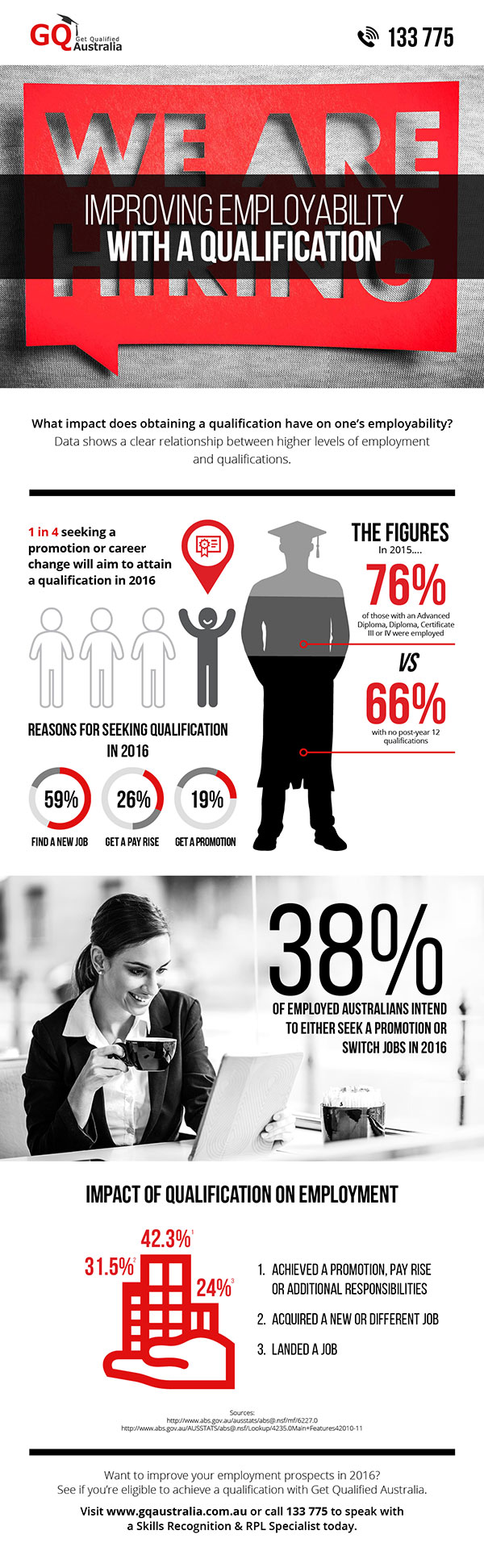
Of those employed, 38% of the represented sample expressed an intention to either change careers and/or seek a pay rise within their current role. Majority were in either full or part-time employment, working within the professional/managerial and sales/clerical industries, and earning $100,000 or more. The Northern Territory and ACT presented the highest percentage of employed persons seeking a career change and/or seek a pay rise.

3.2 Intention to study and/or seek additional qualifications

A quarter of the sample conveyed an intent to undertake study or seek additional qualifications in 2016, with the highest percentage of those being from Rural South Australia. Those with postgraduate qualifications were identified as being more likely than any other category to seek additional qualifications, followed closely by those with basic vocational qualifications.

3.3 Reason for studying and/or seeking additional qualifications

The primary reason specified for undertaking study or seeking additional qualifications in 2016 was to acquire a new job (59%), followed by pay rise motives (26%).


3.4 Reason for not studying and/or seeking additional qualifications

Results showed that more than half (53%) of those interviewed didn’t think they needed qualifications, while a quarter found the whole process too expensive. The length of time it took to acquire a qualification deterred over 15% from seeking a qualification or additional qualifications.

4. Discussion

It is clear from the results that, while more than half of Australians are happy with their current careers, more than a third are hoping to change jobs or seek a pay rise, up 4% from 2014 (Roy Morgan, 2014). This increase in career development motives presents an alarming statistic for businesses and HR professionals hoping to retain their staff. With a large proportion of employed Australians being led by pay rise motives, the need for organisations to revaluate their retention and recruitment strategies proves paramount as a means to ensure ongoing customer satisfaction and motivation.

While the number of employed Australians seeking better career opportunities is high, it is interesting to note that only one quarter are willing to realise their career aspirations through formal certification. The fact that people find the process of acquiring a qualification both time-consuming and expensive, or on the other end of the spectrum, unnecessary, points to the pending need to identify a cost and time-effective means of acquiring a qualification.

Although quick online courses, or ‘fast qualifications’ have reduced the need to study full-length, high-cost qualifications, their validity both within the educational sector and industry has been disputed.

The proliferation of legitimate qualification methods that enable low-cost, time-efficient accreditation endorsed by both industry and Government, such as Recognition of Prior Learning, will enable a larger proportion of employed Australians to fulfil their career development goals through the attainment of qualifications.

References

Australian Bureau of Statistics 2012, Learning and Work, Australia, 2010-11, Cat. no. 4235.0, Australian Bureau of Statistics, Canberra, accessed 25 February 2015,

Australian Bureau of Statistics 2015, Education and Work, Australia, May 2015, Cat. no. 6227.0, Australian Bureau of Statistics, Canberra, accessed 25 February 2015,


Improve

How to Improve Visa and Migration Prospects Through RPL

If working in Australia seems like an unreachable dream, think again. Through Recognition of Prior Learning (RPL), many foreign workers are able to gain the necessary visas and migration documents faster, easier, and with minimal expense. Landing that perfect job with one of Australia’s profitable companies is something anyone with skills in a number of different occupations can look forward to by collating evidence of their experience, and documenting their skills.

Allowing your experience to work for you, even if it was not gained in Australia, can earn you the qualifications, certifications, or degrees you need to get hired by one of Australia’s top companies, startups, small businesses, or international firms. All you need to do is seek out the qualification best suited to your background, apply for an RPL assessment, then follow the steps to receive official recognition for things you already know.

It doesn’t matter whether you’ve learned skills on the job, as a volunteer, pursuing a hobby, researching on your own, or through a job in another country, what you know can help you get a big head start by earning the credentials you need. Migration to Australia and award of a 457 Visa, or Temporary Work/Skilled Visa will come to you faster and easier than you ever imagined.

A 457 Visa allows you to come to Australia to work for a nominated sponsor for up to four years. You are eligible for this visa if you have the required skills to fill an open position in an approved business. This visa allows you to bring your family to Australia to work or study, as well as travel in and out of Australia as frequently as you wish. You will also need a valid passport to apply for a 457 Visa.

Migrating to Australia by presenting experience and background along with an Expression of Interest (EOI) on the Australian Government’s SkillSelect site can help match you up with an appropriate company for nomination. Skills most in need for 2016 in Australia, according to several career sites, list accountants, architects, bankers, construction, education, energy, engineering, health care, information technology, legal, oil & gas, resources & mining, and sales & marketing as top categories for prospective employment.

Australia has a need for skilled workers in a number of additional fields. If you have experience in computers, electronics, design, or a trade like cabinet maker, panel beater, or glazier, there are many positions just waiting for your application and many companies willing to help you acquire the necessary documents to fill the position.

You can proceed through the process in pursuit of a skills category, pursuing a Skilled Independent Subclass 189 Visa to fulfill your dream. Or, if you can match your skills to a company job posting, you can enlist their help in speeding approval of your Skilled Nominated Subclass 190 Visa or 457 Visa, getting you to the head of the line, living and working in Australia usually within 6-18 months of application.

According to the Australian Bureau of Statistics, workers in Australia worked 1,656.0 million hours in January of 2016. That is an increase of 10.9 million hours, or 0.7% over the previous month. An RPL assessment and evaluation could put you on your way to becoming a part of those numbers, working in a position that makes the most of your experience. Ready to make your move? We thought you’d say yes.

How one qualification changed my life and 10,000 others

How one qualification changed my life (and 10,000 others)

RPL recognises your informal learning – such as on-the-job experience – which means you can achieve your goal faster in a cost effective way, with less effort thanks to years of hard work.

What I discovered when I was working in educational institutions is that few people understand RPL. There is often no clear-cut process or criteria for providing appropriate evidence of knowledge gained through work experience. That’s when I realised there was a market for someone to come in and help. I think of Get Qualified Australia as being a life and education coaching service, assisting people reach their full potential through qualifications.

We’ve helped roughly 10,000 people get qualified in the past three years, giving them more choices and the potential to earn more money. Our clients have gained promotions, been able to change industries, been able to apply for positions that were previously out of their reach, or been able to meet stringent migration and visa requirements.

I see the impact education has on people’s lives every day in our customer testimonials. Many say they are treated differently and with more respect once they have a qualification. It boosts their self-esteem. They are often motivated to go further, reach higher and attain another qualification.

A qualification is like a reward for all your hard work. You’ve done the hard work. In fact, you’ve learnt the hard way. The easy way of learning is sitting in a classroom and learning.

A qualification is the ultimate investment: it is an investment in yourself.


Get Qualified Australia can help with RPL and gap training to gain a nationally recognised qualification in a speedy and cost-effective way. For more information please contact Get Qualified Australia on 133 775 or visit www.gqaustralia.com.au

YearsOffDegree

Hidden regulations could cut years off university degrees

The issue of young people starting their careers with crippling education debts is a hot topic. A diploma can leave a student with $25,000 owing to the government. The debt for an undergraduate degree averages $48,000 and is constantly rising. A masters degree can set a graduate back another $30-60,000.

It’s hard enough for school leavers to have these sorts of numbers hanging over their heads. Now imagine incurring that debt mid-career, with a family to support and a mortgage to pay. On top of that, few Australians have the capacity to take years away from work to study. If they want that ‘piece of paper’, they face years of evening classes and studying weekends – time away from family and hobbies.

And the final indignity: older students sometimes spend this time and money “learning” subject matter in which they are already an expert, thanks to years spent working in the industry.

It is a situation many people in their 30s and 40s find themselves in. Years of practical experience in an industry, but careers which have ground to a halt because they need a certificate, diploma or post-graduate degree to get to the next level. But given the investment of both time and money required to get that piece of paper, it is little wonder that many struggle to gain the qualification necessary to improve their careers and lives.

The government is finally recognising that the traditional model of education is not appropriate for everybody. Instead of a one-size-fits-all approach, the move is towards a customised education system that recognises not only prior qualifications, but relevant work experience. In the education world, it is known as Recognition of Prior Learning, or “RPL”.

‘People need a solution that is customised for them,’ says Adam Wadi, CEO of Get Qualified Australia. ‘A customised model combines recognition of what you know and a training plan to fill in the gaps of what you don’t. Together it provides the fastest, most cost-effective path to gain the qualification’.

The notion that the only way to learn is to attend classes scheduled at times and in places that suit the education provider is also being challenged in today’s environment.

There are certainly advantages of attending classes in person. There’s the social aspect of working together and a plethora of clubs and societies students to join. Many students need the incentive of regimented class times and being marked for attendance. Friendships are forged and future contacts made. But the importance of these aspects diminish as a person gets older.

‘A person who is mid-career is more likely to have the motivation and self-discipline to study independently,’ says Wadi. ‘And they already have a social life, maybe even a family. They don’t need to physically attend a college or university for these things.’

Mid-career students looking to attain the next qualification need to explore every avenue to have their workplace knowledge and expertise recognised. They should be entitled to exemptions where they already have sufficient knowledge to pass the unit. There should be options to take classes online for subjects where workshops or physical presence in a classroom are unnecessary.

The most important aspect is RPL. ‘Why should you have to pay to learn something you already know and can prove you know?’ asks Wadi.

Unfortunately, many institutions are not equipped to help students recognise and supply the evidence of prior learning required to get the exemption/s they deserve. RPL is an administrative task, and not one that produces any income for the university or college. They’re not set up to service individual applications, and it is not in their best interests to promote RPL.

As a result, many people don’t realise that they may be able to get credit thanks to what they already know.

‘The education shake-up needs to start with educating people on RPL,’ says Wadi. ‘When people realise a higher qualification is achievable, they are more likely to reach for the stars’.

Get Qualified Australia can help with RPL and gap training to gain a nationally recognised qualification in a speedy and cost-effective way. For more information please contact Get Qualified Australia on 133 775 or visit www.gqaustralia.com.au

NewYearNewCareer

New Year, New Career? Know When to Stay and When to Go

Jobs are essential in modern economies. A steady paycheck in exchange for work performed is usually how it’s done. That’s all well and good, but what about you? Are you fulfilled? Challenged? Performing to potential? Is your boss a mentor and your workload manageable?

In the 21st century, vertical career ladders have become jungle gyms, with longevity and loyalty measuring up against productivity and profitability. If you’re looking around, exploring your options, it can be a struggle to make a decision on whether to stay put or move on.

If you can’t decide whether to stay or go, think about these statements and whether or not they apply to you. If you can’t claim at least one of them, it is probably a good time to consider switching horses.

I have a satisfying job description and feel I play a vital role in my organisation.

Congratulations! You are among the happy campers out there that should probably stay put until something changes. Still, staying in touch with the world around your industry is a good idea.

Explore what other firms are doing and then learn all you can. It will help you with your present post, and give you a leg up if you decide to make a change. Not so satisfied? Explore why you feel that way. If it is something that you can change by engaging, give it a shot. If not, discretely begin to look around.

I am satisfied with the salary I receive for the work I do.

If you are making a comfortable salary that compares favorably with what others are paid for your position, location, and industry, cheers, mate! If you feel you could be earning more by making a switch, it may be time to dig into some statistics to see where you stand. If it looks like it’s in line, great. If not, think about what the going rate is and consider asking for a raise.

Timing is everything here so do a little research, then schedule your meeting. Remember, you don’t get what you don’t ask for. Be prepared for either answer, or even to negotiate, knowing what is, and isn’t, an acceptable bump.

My boss is a great leader and mentor.

Few people get it 100 percent right all of the time, but if your boss is doing things right most of the time, and you’re learning things along the way, you’ve probably got a position worth keeping. If you feel undervalued, and leadership is not forthcoming or you’re not learning from the experience, it may be in your best interest to explore your options.

A good leader that can help you grow and advance is a jewel. Even if things are difficult, but you’re gaining valuable industry expertise, it may prove worth your while to stick it out for a stretch. Knowledge is power. Get some, then use it wisely.

My workload is about right and I am working to my potential.

If you’re working a regular week, with a time crunch every now and again, and you are challenged to function to your full potential at least some of the time, that’s a good sign. If you’re always putting in overtime hours for a basic salary without a little something extra in your paycheck, and your potential is but a dream while you’re scrambling to just get bases covered, you’re going to burn out.

Heavy workloads are OK once in a while, but if that’s the norm, get thee to the job bank to at least review some alternatives. Always being jammed up, schedule-wise, allows little time for proper planning and creative problem-solving. You deserve better and may want to move on to a more efficient operation.

My organisation is on a solid path for a successful year.

If your job tucks you into an organised structure with some room for growth and creative progress, consider yourself lucky. If there are rumors, secret meetings, and suspicious glances running rampant, without an explanation of what things look like going forward, that’s a sign.

Listen to the industry buzz, ask questions of your managers if it seems appropriate for your industry and position, and talk with suppliers to learn what’s what within your organization’s framework, then decide if you want to be a part of the plan. Always give your boss the opportunity to explain any unsettling talk that is “going around,” as things are often not what they seem. If the answer isn’t satisfactory, put the wheels in motion to tidy up the resume.

Before You Jump …

Even if you found that none of these statements apply to you, don’t despair. Sometimes a simple change of focus can open new doors to a more suitable career, or even polish up a tarnished one. Once you decide whether to stay in the same industry or make a more challenging switch, research the skills, education, and experience you need to make the changes you’re considering, then make your plans so that next time you review your stay/go checklist, you’ll be right where you should be.

BellBoy

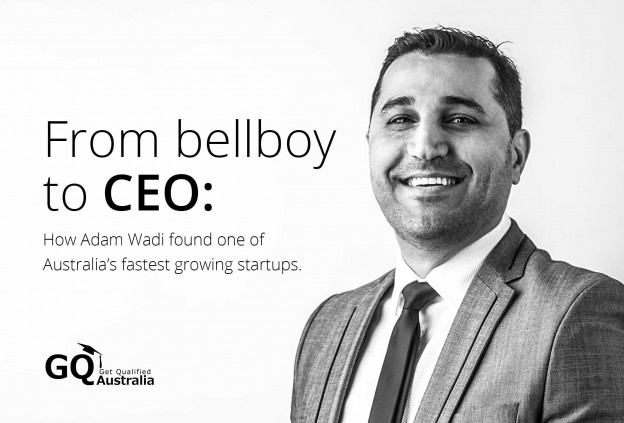
From bellboy to CEO: How Adam Wadi found one of Australia’s fastest growing startups

As a child, Adam Wadi dreamed of a career in hospitality, and as a young adult, he made it happen. Becoming a bellboy in Dubai gave him an entrée into the world of five-star hotels. Hard work saw him rise through the ranks to management positions in a variety of first-class locations.

Like many, he saw a career in hospitality as a chance to indulge in a life of freedom and travel. But the truth was being chained to the hotel lobby with long, unsociable hours for low pay. All the best jobs went to those with qualifications.

Adam knew a Masters Degree in hospitality would pave the way to the freedom and lifestyle he craved. Like most people about to start a family, however, he didn’t have the luxury of being able to study full time for the qualification that he would need to make the move into training and education.

Even more frustrating was that half of the units he would have to study (and pay for) dealt in subject matter he knew better than the lecturers; knowledge gained from years working in the trade. It seemed so pointless. ‘Hospitality is my industry,’ Adam says. ‘I knew it backwards’.

Discovering Recognition of Prior Learning (RPL)

Luckily for Adam, he found a mentor who introduced him to the concept of Recognition of Prior Learning, or RPL. Together they navigated the university’s requirements to prove his expertise and gain exemptions for some units of study. Adam was credited for two introductory units. The saving of $5000 and shortening his course by six months gave him the incentive to enrol and eventually achieve his Masters.

‘If it wasn’t for that person showing me how to RPL myself through a qualification that I needed to move to the vocational education industry, I would never have moved,’ says Adam.

A qualification led to a better life

That qualification opened up a new world for Adam. He got his first training job while still working at a hotel. But after a while he found that his new part-time job paid more than his old full time job, and it was an easy decision to replace his hotel hours with more teaching. He became a full time trainer and assessor.

Adam soon realised that, like him, many people were unaware of RPL and were spending time and money taking classes they believed were necessary to graduate. Even worse were those who never enrolled in a life-changing qualification because they couldn’t afford the investment of time or money.

‘These are smart people, but sometimes they need a little guidance to see their own true potential and the world of options available to them if they hold that piece of paper,’ says Adam. ‘They have no idea that they can turn their skills, knowledge and experience into nationally recognised qualifications.’

That’s when Adam realised there was a gap in the market that he had the knowledge, skills – and the qualification – to fill.

A new start as an entrepreneur

‘I started Get Qualified Australia in my daughter’s room with just a phone and answering machine,’ says Adam. ‘Today I have a hundred employees and we have helped around 10,000 people receive the qualifications they are eligible for’.

He likens what he does to being a coach, guiding clients to unlock their full potential, which gives him immense satisfaction. ‘If it wasn’t for RPL, I would still be working in a hotel,’ Adam says. ‘I just want to give others that same opportunity.’

Get Qualified Australia can help with RPL and gap training to gain a nationally recognised qualification in a speedy and cost-effective way. For more information please contact Get Qualified Australia on 133 775 or visit www.gqaustralia.com.au