Australians weighed in on their career and study intentions for 2016 in Get Qualified Australia’s 2016 Employment and Qualifications Poll, proving that career change aspirations are on the rise.
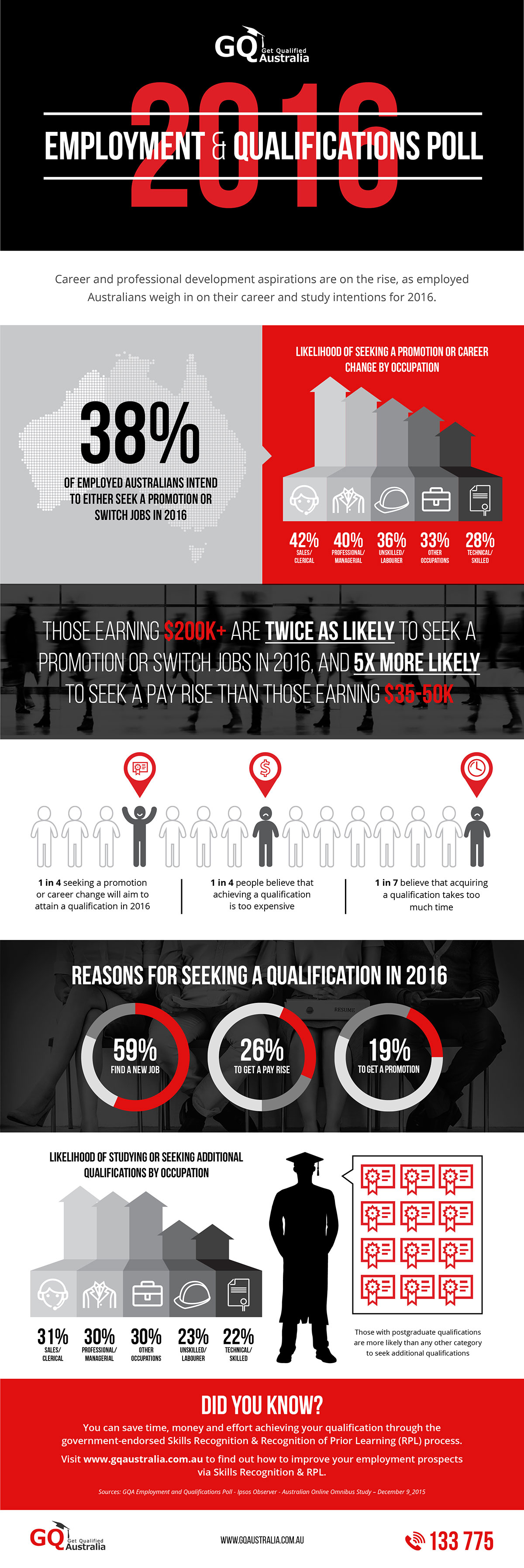

Australians weighed in on their career and study intentions for 2016 in Get Qualified Australia’s 2016 Employment and Qualifications Poll, proving that career change aspirations are on the rise.

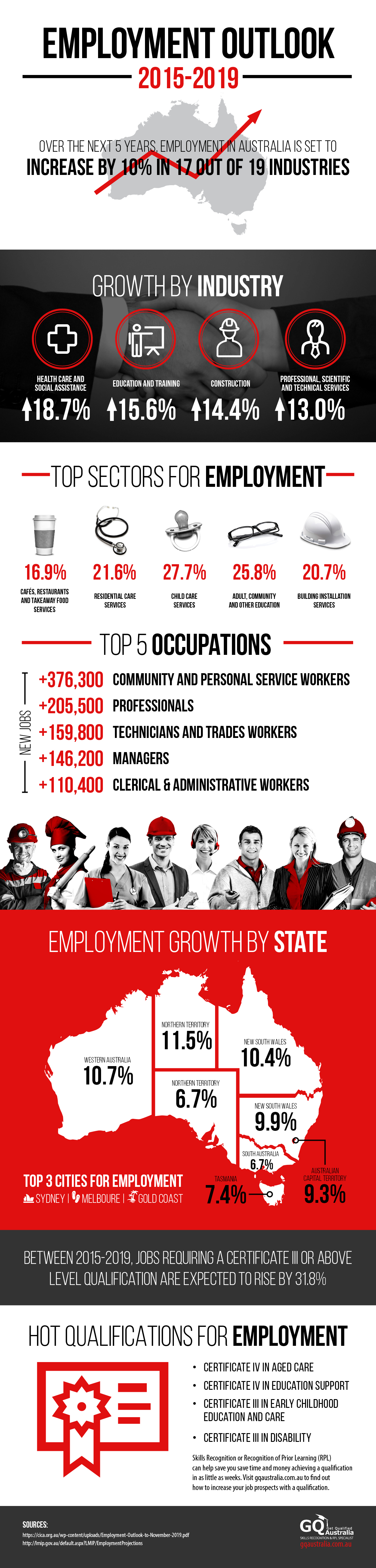
Examine the top employment growth opportunities in Australia between 2015-2019, and find out how to improve your job prospects with skills recognition & RPL.

Note: Please note that Get Qualified Australia is neither involved in nor endorses the China-Australia Free Trade Agreement. As Australia’s leading Skills Recognition & RPL Specialist, it seeks to improve the employment prospects of Australian workers through skills recognition services and the issuing of Nationally Recognised Qualifications.
The China-Australia Free Trade Agreement (ChAFTA) has caused much controversy since being signed in June 2015, particularly within industries directly affected by the Agreement. However, despite the apparent backlash, it is important to consider whether the Agreement really poses as great a risk to Australian jobs and workplace safety as presumed, or whether there are ways to bypass and limit the potential negative repercussions the Agreement may have on the above factors, by working it to the advantage of Australian workers.
Want to know more about ChAFTA and how to improve your employment prospects? Read more here.
Note: Please note that Get Qualified Australia is neither involved in nor endorses the China-Australia Free Trade Agreement. As Australia’s leading Skills Recognition & RPL Specialist, it seeks to improve the employment prospects of Australian workers through skills recognition services and the issuing of Nationally Recognised Qualifications.
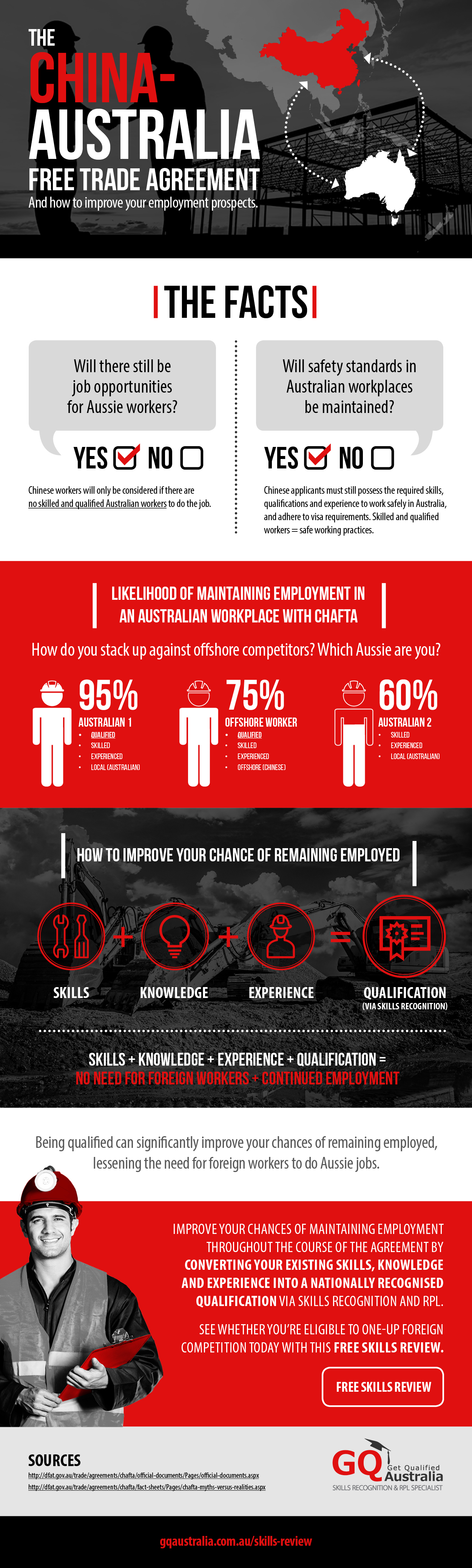
View the China-Australia Free Trade Agreement Infographic here.
The China-Australia Free Trade Agreement (ChAFTA) has caused much controversy since being signed in June 2015, particularly within industries directly affected by the Agreement. However, despite the apparent backlash, it is important to consider whether the Agreement really poses as great a risk to Australian jobs and workplace safety as presumed, or whether there are ways to bypass and limit the potential negative repercussions the Agreement may have on the above factors, by working it to the advantage of Australian workers.
To grasp this concept better, it is important to first look at the implications of the Agreement.
At the heart of ChAFTA lies the streamlining of relevant skills assessment processes for temporary skilled labour visas, including a reduction of the number of occupations currently subject to mandatory skills assessment.
This means that Chinese workers looking to apply for an Australian Temporary Work (Skilled) 457 visa, will not be subject to mandatory skills assessment for ten prescribed occupations. These occupations include:
Automotive Electrician [321111]
Diesel Motor Mechanic [321212]
Electrician (General) [341111]
Electrician (Special Class) [341112]
Joiner [331213]
Motor Mechanic (General) [321211]
The removal of assessment practices leaves many questions for Australian tradies, predominantly:
– What safety measures will ensure that Aussie workers have access to job opportunities in Australia?
– What safeguards will ensure that safety standards in Australian workplaces are maintained?
In order to be able to answer these questions, one must first ponder the facts.
Fact 1) Shortage of skilled and qualified labour
Under the Agreement, a Chinese company investing more than $150 million in Australian infrastructure projects must use Australian workers unless the company can prove that there are no existing qualified Australian workers to do the job.
This means that Chinese workers may only be considered for job purposes if there is a shortage of skilled and qualified Australian workers for any given task. Even so, the company or investor may only bring in a limited number of qualified overseas workers who possess the specific skill sets required for the job, and only for a limited period of time when suitable local workers cannot be found.
Summary Points:
– Skilled and qualified Australian workers given job priority
– Chinese workers only brought if there are no qualified Australian workers to do the job
– Limited number of qualified overseas workers may be brought in
Fact 2) Skilled and qualified Chinese workforce
In the event that there is a shortage of qualified Australian workers, any foreign employees brought in must possess all the necessary skills and qualifications required to do the job. The Agreement does not modify the existing experience, skill and qualification-based requirements that foreign workers must possess when applying for a temporary skilled visa, but rather only proposes the removal of mandatory skills assessment procedures by Trade Recognition Australia, within the ten listed occupations.
This means that applicants must still demonstrate to the Department of Immigration that they possess the requisite skills and experience to work in the country, by supplying evidence of work history, qualifications and documents which demonstrate their English language skills. Should the candidate insufficiently prove their competency, or if further verification is required, they must undergo an additional skills assessment conducted by a registered training organisation (RTO) approved by Trades Recognition Australia.
Summary:
– ChAFTA does not change required qualification requirements and skill levels of foreign workers
– 457 visa applicants need required skills, qualifications and experience to work safely in Australia, and adhere to all visa requirements
– Further assessment may be conducted to verify skill levels and competency by a TRA-approved RTO
Fact 3) Maintenance of licensing requirements and safety standards
Because Chinese workers are subject to the same qualification and skill-based requirements as Australian workers, and hold the necessitated levels of competency, the Agreement does not change and/or diminish the licensing requirements or safety standards of Australian workplaces. Competent workers equate to competent work, less hazards, and maintenance of safety standards.
Summary:
– Licensing and qualification requirements maintained
– Safety standards maintained
How to sustain your employability in the face of ChAFTA
Because Chinese workers within major infrastructure projects can only secure positions in which there are no skilled and qualified Australian workers to do the job, it is important for each Australian employee to possess the right skill sets and qualifications to achieve consideration for projects, and essentially, keep their jobs.
If you do not have the required qualifications to work in your industry and wish to either achieve recognition for your existing skills and experience or simply expand the fields in which you are currently qualified, you may do so by attaining a Nationally Recognised Qualification. Attaining a qualification doesn’t have to take years, and can often be done within weeks, from the comfort of your own home.
As a credible method of gaining certification, Skills Recognition & RPL allows you to convert your existing skills, knowledge and experience into a qualification by supplying evidence of your competency against the core and electives units of your desired qualification. This means you’ll be attaining formal recognition for what you already know and are proficient in, whilst proving to employers that you are a skilled, qualified and experienced worker with full competency to work in Australian workplaces.
Qualifying our Aussie workforce will ensure that the need for foreign workers is lessened, the Australian workforce is qualified and given priority jobs, and each individual employee achieves the competitive edge required to remain employable in the face of ChAFTA.
Think you’re eligible to convert your skills and experience into a Qualification? Take our Free Skills Review to find out!

The world is becoming increasingly health conscious with the introduction of mandatory nutritional labeling, health initiatives within the community and workplace, policies and promotion. And if a recent report by Roy Morgan is anything to go by, Australia has certainly jumped aboard the health-conscious train!
June is alive with the sound of “health”. Not only does 16-21 June mark the World Congress’ annual Men’s Health Week, but June is dedicated to raising awareness for Bowel Cancer in Australia. And it’s all with due cause.

GQ staff participating in Bowel Cancer Australia’s ‘Red Apple Day’ on 17 June.
The Roy Morgan Report has revealed some useful facts about Australian health and its implications for health sector practitioners, primarily with regards to opportunities within the field.
THE GOOD
The initiatives must be working!
The Australian Wellness Index reached a new peak in March 2015 after rising consecutively for 15 months. The key health areas that have signalled improvement include:
THE BAD
While the overall health index has improved in 6 of the 7 key health areas, the National Psychological health score has suffered, experiencing an ongoing decline which started back in 2009.
Integrating a range of attitudes and occurrences of mental health issues, the score has revealed that young women aged 18-24 have experienced the greatest decline in psychological well-being driven by factors such as anxiety, depression, panic attacks, stress, demanding schedules and decreased optimism about the future. However, it is important to note that while younger females are subject to experience some form of mental turmoil, men aged 35-49 are more likely than their younger counterparts to undergo psychological health issues.
THE HEALTHY
Despite improvement in most key health areas, the decline in psychological health has opened up opportunities for practitioners within this sector. It will become increasingly important to counteract the drop in psychological health with a greater demand for mental health practitioners. This includes:
The threat of psychological well-being, particularly in areas of anxiety, depression and stress will encompass the combined effort of professionals who offer mental health support, primarily psychologists, mental health workers, nurses, general practitioners and social workers who provide mental health related support.
Vacancies for mental health work have increased by 10.11% in recent years, with the demand for Mental Health and Substance Abuse Social Workers being expected to rise with the addition of 44,130 new jobs between 2015-2018.
While most of the aforementioned professions require degrees, mental health workers can improve their career prospects with a Certificate IV in Mental Health or a Diploma of Community Services Work.
Affecting mainly young women aged 18-24, youth workers are also likely to experience a surge in demand, especially those working within educational institutions and community centers. The outlook for youth workers appears positive, with future employment growth being within the 10th decile, and expected level of future job openings above average (25,000 and 50,000 new jobs by 2018).
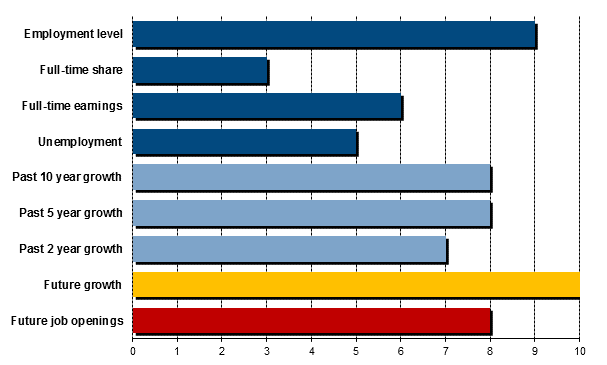
While a youth worker is not required to hold a qualification to carry out their work, an increasing number of employers, especially government agencies, require an appropriate qualification for employment. Holding a Certificate IV in Youth Work or a Diploma of Community Services Work might improve your chances of employment, while filling employer demands.
Although mental health is an area of key concern, it is not the only sector set to experience employment growth. Other health professions with noteworthy projections include Medical Imaging Professionals (31.9%), Occupational Therapists (36.6%), Anesthetists (30.6%), and Nurse Managers (21.6%).
If you don’t already have a qualification but possess the experience, why not achieve one of the following qualifications to acquire a healthy dose of job opportunities.
Advanced Diploma of Nursing (Enrolled/Division 2 nursing)
Certificate IV in Allied Health Assistance
Certificate III in Allied Health Assistance
Certificate III in Health Services Assistance

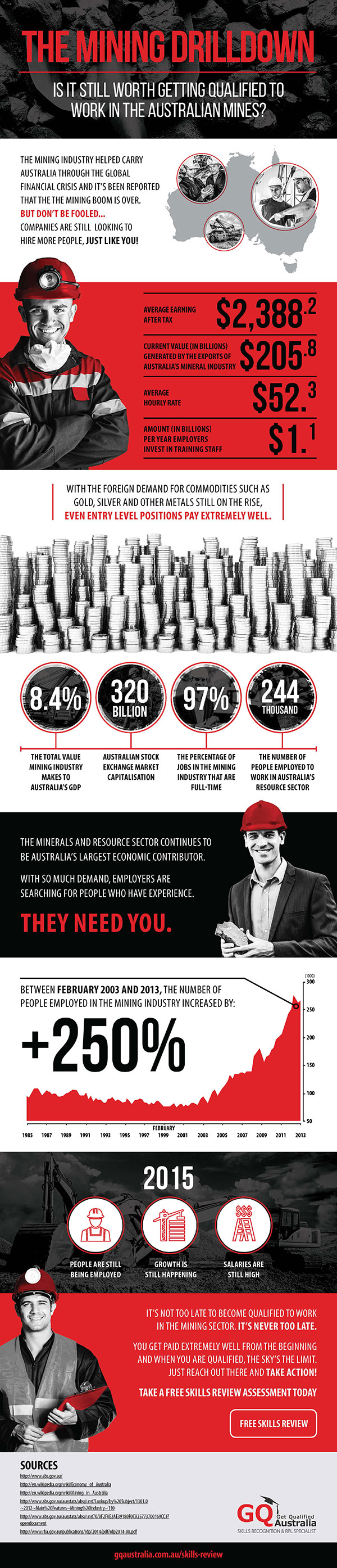
Is the mining industry still worth investing your efforts in? Learn all about the current state of mining in Australia, the opportunities that exist, and how to increase your chances of securing employment within this industry.

“You cannot build a dream on a foundation of sand.”
― T.F. Hodge
The future of Australia’s construction industry may seem doom and gloom amid mining fall-backs, declining investment levels, and rising pressures on resource-related project activity, however calamity is not upon us. Knowing where to invest your employment efforts, and in which sector more precisely, is key to maintaining and increasing your job prospects within the building and construction industry in 2015.
THE BLOOMING LOT: RESIDENTIAL CONSTRUCTION
The value of residential building work is set to rise from $46.2 billion in 2012/13 to 60.9 billion in 2015/16. Of the 183,000 projects expected during this period, the apartment building sector is likely to witness the highest level of growth, with a 6.3% increase in projects.
THE SECURE LOT: COMMERCIAL CONSTRUCTION
Rising at a rate of 3.2%, sustained growth is anticipated within the commercial construction industry. Majority of this growth is expected to occur through private building efforts, including offices, retail premises, and recreational buildings.
THE PROMISING LOT: INFRASTRUCTURE CONSTRUCTION
Despite experiencing declining activity in electricity, sewerage, drainage, water supply, and pipelines, the future for infrastructure construction looks favourable, with an expected growth rate of 5%. Following an increase in investment, primarily from the NBN network, the telecommunications sector seems most hopeful (8.2%), while the Federal and State infrastructure plans for road and rail are expected to witness a revenue lift by 6%. This is followed closely behind by civil projects (5.2%), including port expansion.
THE STATE OF DEVELOPMENT
If you’re a job seeker looking to invest your efforts in solid soil, then knowing where all the activity is happening proves crucial. Fortunately for New South Wales natives, their resident state will be home to a large portion of building and construction activity. This is followed moderately by South East Queensland, and Victoria, and understandably so. States not as exposed to declining mining-related construction, such as NSW and VIC, have greater opportunities.
THE EMPLOYMENT LOT: JOB OUTLOOK FOR 2015
As one of the 16 industries expected to experience increased job offerings between 2015 and 2018, employment within the construction industry is set to grow by 137,900 jobs (13%). While outlooks for heavy and civil engineering construction are projected to suffer marginally, small home builders and occupations with greater exposure to the detached housing and apartment buildings sector, such as bricklaying, plastering, tiling, residential landscaping, and site management, appear to have the most to gain. Of these sectors, the greatest opportunities exist for off-site and sub-contract work.
HOW TO INCREASE YOUR EMPLOYMENT PROSPECTS IN 2015
1. Invest in the booming sectors
There’s no logic behind placing structures in sinking soil. Instead, you should focus your labour on burgeoning sectors. These include residential (apartment buildings), commercial (offices, retail, recreational buildings), and infrastructure construction (telecommunications, road and rail, and civil) industries.
2. Consider off-site and subcontract work
With demand for off-site and subcontract tradesmen eclipsing that of on-site work, it seems more beneficial to take on jobs under these arrangements. While such agreements may not work for you, they might be worth looking into.
3. Up your qualifications and get your trades license
It’s a tough and competitive world out there, and to secure a lot for future employment, you need a solid foundation on which to build. Having all the required qualifications and trades licenses to meet industry requirements and one-up your competition, can increase your chances of getting a job substantially, especially if you’ve got a superior line of skills locked in your tool-kit.
If you can’t afford to take any time off work, then you’ll be happy to know that you no longer have to. Recognition of Prior Learning (RPL) has made it easier than ever to turn your existing skills, knowledge and experience into Nationally Recognised Qualifications which may then be used to acquire your trades license. For more information about licensing requirements, click here.
If you’ve already got a qualification, it might be useful to consider merging into a more burgeoning sector of your industry by obtaining a qualification within that area too, especially if you’ve already got all the skills required to prove your competence. The following qualifications might help you increase your chances of landing a job in 2015.
Diploma Of Building And Construction (Building)
Certificate IV In Building And Construction (Site Management)
Certificate IV In Building And Construction (Building)
Certificate III in Bricklaying
Certificate III in Solid Plastering
Certificate III in Wall and Floor Tiling
SOURCE:
Australian Industry Group, 2014, Construction Outlook

Hospitality workers, rejoice! The travel and tourism sector is thriving in Australia and the days of the Global Financial Crisis look like they are finally behind us. 2014 recorded strong growth yet again in both domestic travel and the numbers of international visitors to the continent.
In fact, TripAdvisor’s recent TripBarometer study indicates that Australia not only remains one of the top dream destinations for many international travellers in 2015, but Aussies themselves are opting to travel local because it’s more affordable.
The sooner than expected depreciation of the Australian dollar along with historically low interest rates spell good news overall for the tourism industry. Employment in Accommodation and Food Services is expected to increase by 13.9% over the five years to 2019, according to the Department of Employment’s latest projections. The latest report released by Deloitte Access Economics also reveals that the tourism and hotel market looks very promising for Australia in 2015 and beyond. Domestic trips grew by over 5% last year, along with a 6.7% increase in overnight stays up to September, which picked up to a record-breaking pace not witnessed in 20 years. Similarly, international arrivals increased by 8.2%, the fastest increase on record over the past decade.
Tourism Australia’s Managing Director, John O’Sullivan announced at the end of 2014 that tourism is the largest services export sector in Australia, totalling a worth of over $101 billion and employing more than one million people nationwide.
In-Demand Job Titles for 2015 – Get Qualified Through RPL
Are you a manager, chef, waiter or kitchen hand? If so, your industry skills will be in the highest demand not only this year, but for the foreseeable future as well, says CEO John Hart of Restaurant and Catering Australia (R&CA).
Are you being served? If you want to move your resume to the top of the pile, get a raise or secure a higher paid position in the industry, make 2015 a time to serve yourself by enhancing your long-term career prospects and gaining some official recognition for your hard earned skills and work experience.
Did you know that you can get qualified in a matter of weeks through RPL (Recognition of Prior Learning), rather than wasting hours studying in a classroom? For anyone looking to significantly expand their employment and salary horizons, RPL is a winning solution!
Calling all Managers and Chefs, if you’re feeling undervalued, underpaid or simply wish to change jobs, consider the Diploma of Hospitality or Advanced Diploma of Hospitality, depending on your experience-level.
Whatever your flavour, if you’re a Commercial Cook, Chef de Partie or Chef Patissier, check out the Certificate III in Commercial Cookery, Certificate IV in Commercial Cookery and Certificate IV in Patisserie for a taste of your qualification options.
Supervisors, Concierges, Head Waiters and Team Leaders come forth and claim your Certificate IV in Hospitality, or become a fully qualified A-grade Waiter with a Certificate III in Hospitality.
Working as a Breakfast Cook, Catering Assistant or Kitchen Hand? Prepare your career at record speed with a Certificate II in Kitchen Operations.
RPL is a simple assessment endorsed by the Australian government that is becoming an envious choice for those who opted for an education before experience career path. Why? Because if you qualify for RPL, there is no classroom study, no tuition fees, no need to take time off work and no need to wait months to get qualified. RPL examines your industry skills and working background and if you already have what it takes, an accredited qualification is yours within just a few weeks. Not only that, it will cost you a fraction of the normal course asking price. So what are you waiting for? Take a free skills review online today to determine your eligibility for one or more nationally recognised qualifications and get the recognition you deserve!

“What is in your meal? Where did the ingredients come from? Were they properly – and safely – handled from every stage, from farm to plate? WHO is advocating for action in these areas on this World Health Day, 7 April 2015, as it calls on producers, policy-makers and the public to promote food safety.” – World Health Organisation
In a globalised food economy, the dangers of unsafe food have become a matter of pressing concern among nations. The latest frozen berry fiasco, causing more than a dozen cases of Hepatitis A in Australia, is but one incident in a steady stream of food scandals that have been brought to light over the past decade. We aren’t the only ones at risk either. In 2007, pet food imported from China spiked with melamine, a toxic industrial chemical, killed a number of cats and dogs in the US. A year later, the same deadly ingredient somehow found its way into infant formula, resulting in the tragic deaths and sickness of young children.
Even medical facilities aren’t safe from the threat of contaminated food. A recent recall of a chocolate mousse product supplied to Australian hospitals is purported to be underway, when it was found to contain the infectious bacteria listeria, which is particularly dangerous for pregnant women, the elderly, or anyone with a weak immune system.
But that’s not all. It seems like almost every product on sale carries with it the potential risk of infection, disease and even death. The best case scenario is that you’re buying a watered down or fraudulent version of the original, such as the undisclosed use of horsemeat in beef burgers sold in British and Irish supermarkets a couple of years ago. At worst, you’re literally playing Russian roulette with your life.
“Foodborne and waterborne diarrhoeal diseases kill an estimated 2 million people annually, including many children.” – WHO
The WHO has identified over 200 diseases that can be contracted from consuming unsafe food contaminated with harmful viruses, bacteria, parasites and chemicals.
Is food safety at the top of the list?
Promoting and implementing safe food production standards, from farm to fork, is of prime importance as the world population continues to grow and there are more mouths to feed. With each new food-related fatality, our consumer trust is being eroded. Our faith in the global food supply has been shaken and it’s gradually falling out of favour, at least for those who can afford to buy food that’s locally grown, and produced by independent, small-scale, organic farmers.
The increasing number of incidents originating out of Chinese goods also begs the question of why we continue to import from this country and others like it that consistently fail to live up to basic food safety and hygiene expectations. China already suffers from high levels of air, water and soil pollution. Add ‘honey-laundering’, the use of banned pesticides, selling rancid meat and exporting contaminated frozen berries, and it’s easy to feel suspicious and mistrustful. After all, it’s your health you’re bargaining with, which isn’t something to be taken lightly, especially when there are kids involved. At the end of the day, the processes involved in food production shouldn’t put profit first and safety second.
However, despite several food scares at home, Australia thankfully ranks very highly when it comes to food safety standards. The domestic food and beverage industry forms a vital part of the economy and maintains an international reputation for supplying clean, healthy produce with a low chemical count, including meat, dairy, grains, fruit and vegetables, seafood, confectionary, wine, organic food stuffs and other specialty products.
We have state of the art education and training facilities in this industry sector and this has succeeded in developing an incredibly skilled workforce, says the Australian Trade Commission (Austrade):
“Right across the supply chain, the Australian food and beverage industry has adopted innovative manufacturing, packaging, product development and marketing efforts. From paddock to port, the industry is supported by reliable and world-class transport and distribution infrastructure.”
Employment opportunities
Food processing accounts for about 20 per cent of all manufacturing operations within Australia and 18 per cent of employment in manufacturing is associated with the food processing industry, making it a desirable avenue for job seekers as opportunities for future growth persist in an already lucrative export market.
“Opportunities for Australian processed foods exist in every market – with Japan the number one market, followed by the USA, Korea, Indonesia and New Zealand. Australia’s excellent environmentally sustainable safety credentials, as well as its disease-free status, are also backed by a strong regulatory framework, and innovations in traceability, quality assurance and supply chains.” – Austrade
General qualifications in the trade include the Certificate III in Food Processing, which covers a broad range of industries, such as grain processing, dairy processing, grocery staples, poultry, beverages, confectionary and fruit and veg. A Certificate III in Retail Baking also offers another point of entry, providing an opportunity to develop specialised skills baking cakes, pastries or bread for those who prefer to work in a retail environment.
Are you employed in the food processing industry? Get qualified with RPL
Many people are unaware that Recognition of Prior Learning (RPL), an Australian government endorsed assessment, enables existing workers, or those with industry specific skills, knowledge and experience to obtain a nationally recognised qualification without ever setting foot in a classroom. Have you been employed in the food processing industry? If so, why not take a free skills review online and let a qualified RPL specialist advise you of any qualifications that you could be entitled to at a fraction of the original course cost. A qualification in your field could radically improve your career prospects in 2015 and beyond.
Get Qualified Australia, the nation’s leading experts in RPL, offer a number of relevant qualifications, such as the:
Certificate III in Food Processing
Certificate III in Retail Baking (Cake and Pastry)
Certificate III in Retail Baking (Bread)
Certificate III in Retail Baking (Combined)
Certificate III in Commercial Cookery
Certificate IV in Commercial Cookery
Certificate IV in Patisserie
Grow your career and help contribute towards the security, safety and improvement of our food supply so that we can continue to adopt the best hygienic practices in food production and provide healthy nourishment for families, children and pets at home and abroad.

Have you ever wondered what your purpose in life is? It’s a common philosophical question that most of us struggle with, yet many don’t even come close to reaching the right answer. But why do humans exist in the first place? Who or what put us here? Is it to accumulate wealth and material objects? Is it to make a name for ourselves and compete with one another for the top spot, so that we can stand alone on top of our ivory tower and lord it over those who didn’t make it? Is it to be the best we can be, at the cost of those who are disadvantaged to begin with, who may never get a chance to rise up through the ranks of society’s established hierarchies?
Discrimination, abuse and inequality persist even in developed countries, which requires a serious re-think on those critical humanitarian matters that still require drastic improvement. After all, what’s the point in being successful if people are still suffering on a daily basis even in our own community? Are we supposed to ignore their plight and absolve ourselves of any blame and responsibility?
Whether we have a hand in it or not seems irrelevant. The fact is that these problems exist and it’s up to us to fix them. Who else will?
What should unite each and every one of us is our very humanness. We have a social responsibility to one another because the world isn’t ruled by a single person. We all comply whether we like it or not, and therefore the power actually rests squarely on our shoulders.
As Nelson Mandela once proclaimed on the issue of tackling world poverty:
“Overcoming poverty is not a task of charity, it is an act of justice. Like Slavery and Apartheid, poverty is not natural. It is man-made and can be overcome and eradicated by the actions of human beings. Sometimes it falls on a generation to be great. YOU can be that great generation. Let your greatness blossom.”
So let’s consider a compromise. Maybe the secret to a rewarding career isn’t precipitated by burning ambition just for ambition’s sake. Perhaps it need not be wholly fixated on excessive financial gain, simply to buy extravagant jewels, designer clothes, imitate Hollywood celebrities and essentially play house. Do we all need to aspire for untold riches the likes of which only the super elite has ever (and probably will ever) experience?
If you can put food on the table and have a roof over your head, you’re already one of the lucky ones. It’s time to take a step back out of the bubble, have a good look around and ask a simple question: What can I do to help?
This doesn’t mean donating your hard earned cash to charity, which is essentially passing the torch over to somebody else to do the actual ‘helping’. You could get paid to be the help instead, to do honest, meaningful work with no bells and whistles attached, but rather what needs to be done to make the world we live in a beautiful place, and to feel good about the earth as somewhere we all call home.
Still not convinced? Well here’s a few random facts to stoke up the fire within and awaken your social conscience.
In Australia alone:
Are any of these issues hitting home at all? Maybe you’re already an advocate for your community and are doing everything in your power to help eradicate some of these problems once and for all. Take your pick, there’s something for everyone to get involved with on a local level without ever having to look beyond the borders of their town, city or state. The aforementioned statistics only really skim the surface.
A Career in Community Services
According to the Australian Community Workers Association (ACWA):
“A community worker is a qualified person who, through professional training and field education, has the knowledge, skills and values to work in a social welfare agency or program intended to promote or restore the social functioning of individuals, families, social groups or larger communities….Promoting social justice and maximising human potential are cornerstones of community work.”
Have you got what it takes to be a community ambassador? Whether you wish to help families, women and children in need, indigenous and multicultural communities, our ageing population, the disabled, or people dealing with mental health problems, addiction and substance abuse, there are a wide range of specialised areas that you can put your skills to good use. You can make a real difference in the lives of those who are unable to fully support and care for themselves.
Isn’t that what ‘success’ should really be about? A collaborative effort to help everyone, not just ourselves, discover their true potential and get fair, equal treatment. If even one person suffers from discrimination in any form, then the society that they were born into has failed them. Simple as that. It is thus our social duty to correct these types of wrongs because we’ve been dealt a better hand than most. More than that, we have the power to resolve them rather than use our talents strictly for personal gain. We must give a voice to the voiceless. We must not muffle their cries for help. We can’t be selfish.
How to Get Qualified
The Department of Employment predicts that Healthcare and Social Assistance will provide the strongest employment growth out of any sector between 2015 and 2019, so there’s no better time to start your community services career by obtaining at least a Certificate III in Community Services Work. From there, you can decide on your token specialty after you’ve had a taste for the type of work on offer.
Got the skills, but lack the qualifications? Did you know that RPL (Recognition of Prior Learning) allows you to convert your knowledge and previous work experience into a nationally recognised qualification without any classroom study? So if you’ve volunteered at length in the past, or have useful expertise working in the field, you may be automatically entitled for an accredited certificate or diploma within weeks. Take a free skills review to find out where you stand.
Popular qualifications available through RPL include the:
Diploma of Community Services Work, and
Vocational Graduate Diploma of Community Sector Management.