
Category Archives: RPL

Blogging about RPL – what is happening – what is new there. Recognition of Prior Learning is endorsed by the Australian government

Blog Image Early Education

Go to the Head of the Class: RPL Early Education Diploma

If you’ve been working to nurture and educate children as a career, your experience may earn you an official qualification through Recognition of Prior Learning (RPL). The care and keeping of babies, toddlers, and preschoolers requires valuable skills, ones that RPL as a program is equipped to both recognise your skills and rewards your accomplishments, based on the merit of what you already know. Through RPL, earning your Diploma in Early Education and Care is a real possibility. You’ll boast your credentials quickly and easily, at a cost of thousands less than earning a degree through a traditional diploma program.

Experienced child care staff are hard working, multi-tasking, managers of multiple entities in an early education classroom. Keeping an eye on safety and hygiene while ensuring good nutrition and hydration, teaching basic skills to children in this setting requires patience, planning, and flexibility. These skills are in demand, and those holding an appropriate child care qualification often earns preferred status when applying for the best positions.

Whether you’ve learned these skills raising your own family at home, taking responsibility for other children, on the job, as a volunteer, or even in a formal classroom setting, your knowledge is key to advancing your career with the enhanced status this qualification provides. Isn’t it about time you got credit for the things you already know?

Writing lesson plans, scheduling field trip outings, and collecting materials for special projects, your days are full of important details that must be completed with skill. Keeping the classroom clean and tidy requires both good time management and knowledge of cleaning methods most appropriate to the task. Keeping the children in line, engaging their attention and inspiring their learning environment requires an experienced hand tempered with a little psychology.

If you’ve been working in this arena, you know the challenges, but you also know the rewards. There is nothing like the big hugs and lovely smiles from children that you’re mentoring, giving them skills as simple as tying a shoe, stacking a block, or counting with numbers to keep your day on track. Similarly, knowing how to turn contentious situations into helpful, positive, teachable moments is invaluable as children learn about social interaction.

Skilled early education and care workers know the drills and truly keep chaos at bay on a daily basis. If you are good at what you do and this is your chosen career field, why not boost your status and improve your employment prospects with this important credential. Your Diploma of Early Education and Care through an RPL program awaits, ready to elevate you to the next level. It’s time to graduate, so schedule a review for an RPL assessment today.


Improve

How to Improve Visa and Migration Prospects Through RPL

If working in Australia seems like an unreachable dream, think again. Through Recognition of Prior Learning (RPL), many foreign workers are able to gain the necessary visas and migration documents faster, easier, and with minimal expense. Landing that perfect job with one of Australia’s profitable companies is something anyone with skills in a number of different occupations can look forward to by collating evidence of their experience, and documenting their skills.

Allowing your experience to work for you, even if it was not gained in Australia, can earn you the qualifications, certifications, or degrees you need to get hired by one of Australia’s top companies, startups, small businesses, or international firms. All you need to do is seek out the qualification best suited to your background, apply for an RPL assessment, then follow the steps to receive official recognition for things you already know.

It doesn’t matter whether you’ve learned skills on the job, as a volunteer, pursuing a hobby, researching on your own, or through a job in another country, what you know can help you get a big head start by earning the credentials you need. Migration to Australia and award of a 457 Visa, or Temporary Work/Skilled Visa will come to you faster and easier than you ever imagined.

A 457 Visa allows you to come to Australia to work for a nominated sponsor for up to four years. You are eligible for this visa if you have the required skills to fill an open position in an approved business. This visa allows you to bring your family to Australia to work or study, as well as travel in and out of Australia as frequently as you wish. You will also need a valid passport to apply for a 457 Visa.

Migrating to Australia by presenting experience and background along with an Expression of Interest (EOI) on the Australian Government’s SkillSelect site can help match you up with an appropriate company for nomination. Skills most in need for 2016 in Australia, according to several career sites, list accountants, architects, bankers, construction, education, energy, engineering, health care, information technology, legal, oil & gas, resources & mining, and sales & marketing as top categories for prospective employment.

Australia has a need for skilled workers in a number of additional fields. If you have experience in computers, electronics, design, or a trade like cabinet maker, panel beater, or glazier, there are many positions just waiting for your application and many companies willing to help you acquire the necessary documents to fill the position.

You can proceed through the process in pursuit of a skills category, pursuing a Skilled Independent Subclass 189 Visa to fulfill your dream. Or, if you can match your skills to a company job posting, you can enlist their help in speeding approval of your Skilled Nominated Subclass 190 Visa or 457 Visa, getting you to the head of the line, living and working in Australia usually within 6-18 months of application.

According to the Australian Bureau of Statistics, workers in Australia worked 1,656.0 million hours in January of 2016. That is an increase of 10.9 million hours, or 0.7% over the previous month. An RPL assessment and evaluation could put you on your way to becoming a part of those numbers, working in a position that makes the most of your experience. Ready to make your move? We thought you’d say yes.

BellBoy

From bellboy to CEO: How Adam Wadi found one of Australia’s fastest growing startups

As a child, Adam Wadi dreamed of a career in hospitality, and as a young adult, he made it happen. Becoming a bellboy in Dubai gave him an entrée into the world of five-star hotels. Hard work saw him rise through the ranks to management positions in a variety of first-class locations.

Like many, he saw a career in hospitality as a chance to indulge in a life of freedom and travel. But the truth was being chained to the hotel lobby with long, unsociable hours for low pay. All the best jobs went to those with qualifications.

Adam knew a Masters Degree in hospitality would pave the way to the freedom and lifestyle he craved. Like most people about to start a family, however, he didn’t have the luxury of being able to study full time for the qualification that he would need to make the move into training and education.

Even more frustrating was that half of the units he would have to study (and pay for) dealt in subject matter he knew better than the lecturers; knowledge gained from years working in the trade. It seemed so pointless. ‘Hospitality is my industry,’ Adam says. ‘I knew it backwards’.

Discovering Recognition of Prior Learning (RPL)

Luckily for Adam, he found a mentor who introduced him to the concept of Recognition of Prior Learning, or RPL. Together they navigated the university’s requirements to prove his expertise and gain exemptions for some units of study. Adam was credited for two introductory units. The saving of $5000 and shortening his course by six months gave him the incentive to enrol and eventually achieve his Masters.

‘If it wasn’t for that person showing me how to RPL myself through a qualification that I needed to move to the vocational education industry, I would never have moved,’ says Adam.

A qualification led to a better life

That qualification opened up a new world for Adam. He got his first training job while still working at a hotel. But after a while he found that his new part-time job paid more than his old full time job, and it was an easy decision to replace his hotel hours with more teaching. He became a full time trainer and assessor.

Adam soon realised that, like him, many people were unaware of RPL and were spending time and money taking classes they believed were necessary to graduate. Even worse were those who never enrolled in a life-changing qualification because they couldn’t afford the investment of time or money.

‘These are smart people, but sometimes they need a little guidance to see their own true potential and the world of options available to them if they hold that piece of paper,’ says Adam. ‘They have no idea that they can turn their skills, knowledge and experience into nationally recognised qualifications.’

That’s when Adam realised there was a gap in the market that he had the knowledge, skills – and the qualification – to fill.

A new start as an entrepreneur

‘I started Get Qualified Australia in my daughter’s room with just a phone and answering machine,’ says Adam. ‘Today I have a hundred employees and we have helped around 10,000 people receive the qualifications they are eligible for’.

He likens what he does to being a coach, guiding clients to unlock their full potential, which gives him immense satisfaction. ‘If it wasn’t for RPL, I would still be working in a hotel,’ Adam says. ‘I just want to give others that same opportunity.’

Get Qualified Australia can help with RPL and gap training to gain a nationally recognised qualification in a speedy and cost-effective way. For more information please contact Get Qualified Australia on 133 775 or visit www.gqaustralia.com.au

LifeOnHold (1)

How to Get a Qualification Without Putting Your Life on Hold

There’s a great new position opening up and it’s squarely in your wheelhouse. You would be perfect for the job, with all the right experience except for one little detail: you don’t have the required qualifications.

Going back to school after spending a few years, or even a few decades in the working world can seem an impossible plan. Responsibilities at work and home claim most of your time. And then there’s the cost. Traditional schooling can take years to complete, demanding tens of thousands of dollars in the process. There is another option.

Through Skills Recognition and Recognition of Prior Learning (RPL), all of your experience can earn you credit, advancing your academic status before you’ve even stepped foot in the classroom. The things you’ve learned on the job, as a volunteer, pursuing a hobby, or simply maintaining a home, can help you leapfrog over the coursework in your chosen field, saving both time and money on your way to the credentials you need to get ahead.

Through skills recognition, the knowledge you’ve gained illustrates your level of expertise, proving what you already know. Whether you’ve learned skills on the job, in the classroom, working on a hobby, or simply making your way through life’s everyday tasks at home, those skills are useful in getting recognition where it’s due: on your resume and academic record.

Scheduling a consultation with a Specialist, and gathering up information about your experience into a portfolio, will allow you to confirm your eligibilty for a qualification at half the time, effort and cost, without the need for any classroom study or relearning what you already know.

Or perhaps you’re uncertain where all of your expertise could lead. A review with an expert could point you in a new, undiscovered direction with exciting job prospects.

The courses you’ve taken at work, that training you’ve received on the job, or the self-driven study you undertook to solve a particular problem are all valuable in the assessment. The hobby you’ve pursued for years, or the work you’ve done managing household budgets, organising family travel, keeping kitchens stocked and organised, and cooking for a crowd can all help you achieve the status of your dreams.

If you’ve been reading the job posts thinking the answer is “no” because of your lack of education, think again. The evaluation of your portfolio is the first step toward getting to “yes,” as the pieces of your expertise come together, forming a solid foundation from which to launch your career’s trajectory. In less time than you think, costing less than you imagine, you’ll have the credentials you need to pursue the kind of job you deserve.

You’ve been in a holding pattern that’s preventing you from advancing in your chosen field for too long, telling yourself “no” because you lack credentials. It’s time to tell yourself “yes,” learning how valuable recognition is for the important things you do every day.

CertIII_Electro

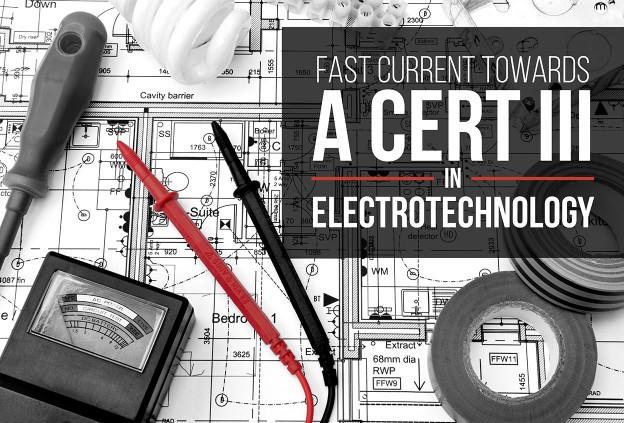
Fast Current Towards a Certificate III in Electrotechnology

Do you know how to assemble and set up basic security systems? Or how to install and maintain cabling for multiple access to telecommunication services? Do you develop and connect electrical control circuits? If these are tasks you regularly perform on the job, as an electrician, in refrigeration and air conditioning, in photovoltaics, or in telecommunications, you may already have the skills and knowledge to earn an impressive new qualification.

Whether you’ve learned your skills on the job, as a volunteer, or are even self-taught, that knowledge could earn you a Certificate III in Electrotechnology. Through Recognition of Prior Learning (RPL), what you know can earn you the qualification you need to get ahead through a simple process of skills recognition. No additional, long hours in classrooms. No expensive study fees. Simply collate evidence which proves that you know all the right stuff (that is, the qualification’s core and elective units of competency), fulfill all qualification requirements, and you could be on the pathway to success.

The Skills Recognition Process

Observe the core and elective units of your qualification. These are the units that you will have to prove your competency in. The aim is to map your evidence against each required unit.

You’ll do this by collating your resume, references, letters of recommendation, and photos and videos of your work. Don’t forget any workshops, seminars, or site competencies you have. If you hold any tickets, such as for forklifts, cranes, elevating work platforms or an electro-related ones, those are helpful as well. Everything will go into your portfolio, building the case for the award of your new credentials.

Scheduling a consultation, or completing a free online skills review is all that is required to get started. Skilled RPL Specialists will help you through the process, advising and directing your efforts. Examples of evidence might include:

• Photos or videos of your work
• Job descriptions
• Memos and letters
• References from supervisors
• Schedules
• Emails
• Performance reviews
• Training diaries
• Meeting minutes
• Samples of work
• Reviews of logbooks
• Forums/meetings/conferences
• References from employers
• Simulations of a work activity
• Role plays
• Team meeting notes
• Anything additional supporting document

Once a portfolio of documentation demonstrates that you can sufficiently perform the required tasks and duties (units of competency), the rest is easy. While the process maintains high standards of confidentiality, if the work you do is protected by Intellectual Property Rights or Trademarks, do check with your employer to ensure you are acting in accordance with the rules.

If you’ve been working with wiring, electronics, cables, and telecommunication equipment, you know these things. Likewise, if you’ve been working in air conditioning and refrigeration, photovoltaics energy systems, LV grids, substation maintenance and operation, or flow maintenance, it is time your valuable skills were given the attention they deserve.

Skills recognition and RPL services leading to hundreds of different qualifications have earned hard-working individuals like you exciting promotions, challenging new positions, and new careers. An easy, online inquiry gets things started, and within a few weeks, you might have already earned the qualification you’ve always wanted.

Electrotechnology is an exciting field with opportunities in construction, multinational corporations, and/or your own business. Recharge your career batteries with an RPL qualification today. It’s the easiest and fastest promotion you’ll ever receive.

RPLFoundation

Building a Future in Construction: The RPL Foundation

Putting in a full day in building and construction trades is hard work. The pay is usually pretty good, and becoming skilled in a trade such as carpentry, painting, tile setting, or plastering, is a reliable way to earn a paycheck. After a few years on the job, however, wouldn’t it be nice to see some progress as far as moving into a supervisory or management role?

If you have the ambition, the drive, and the expertise but not the degree on a piece of paper, and you think that a lack of education might be keeping you from achieving the position you want, we should talk. It is time for you to receive credit for what you know.

You’ve learned a lot on the job from peers, mentors and managers. You know how to run the machinery, order the supplies, and organize the crew. You arrive on time and stay till the job is finished, and you’re ready to take on more responsibility. If that describes your work history, the very first responsibility you should attend to is scheduling a consultation for an RPL assessment.

Recognition for Prior Learning (RPL) is an assessment pathway that reviews knowledge you’ve gained from all kinds of sources, turning it into academic credit for formal certification, like the Certificate IV in Building and Construction. It applies what you know toward a degree or qualification that can move you forward in your career. An RPL assessment will look at exploring all the ways you’ve learned things, from formal classroom education to non-formal and informal learning gleaned from life experiences.

If you’ve taken courses at work, or pursued a hobby with passion, the knowledge gained from the experience can be applied to appropriate certifications and qualifications, earning status, confidence, and perhaps even that promotion you’ve been seeking. If you’ve been performing tasks at home, remodeling a house, helping a friend build a new garage, or reading up on how to act as your own contractor, what you’ve learned may count toward meaningful credit, shortening the path to your certificate or diploma goal.

Licenses, work history, trade papers, and log books or job sheets can all help you to earn credit through trade recognition. So can tickets you hold, such as those enabling you to operate machinery such as forklifts, cranes, or graders. Matching your knowledge and skills with the learning outcomes of formal coursework in similar disciplines allows you to skip over the coursework. Eliminating that overlap can save both time and money, turning your knowledge into the education award of your dreams, faster and easier.

Start by collecting evidence of your experience, from industry awards, photos of your work, references from employers and managers, work history, and trade papers, as well as recognised courses. Make sure you consider every appropriate knowledge resource to get as much credit as you deserve. Then schedule a consultation with an RPL Specialist who will help you take the necessary steps to get your career in the building construction trades on the fast track, building a solid foundation for your future with RPL.

A wall gets built one brick at a time. Framing goes up one board at a time. Shingles go on one nail at a time. But when it comes to earning a building construction qualification, you don’t have to take it one course at a time. Skip what you know, and you’ll see how fast it goes, earning your credentials within the building and construction industries through trade recognition and RPL.

FastTrack_MBA

Using What You Know: The Fast-Track MBA

You’re a professional. You’ve learned the ropes, done the work, and know your stuff. You’ve got the ambition, the drive, and the skills that move winners forward. What’s missing?

If you just said your MBA, that’s about to change.

Going through a Master of Business Administration (MBA) program can be expensive and time consuming. It’s particularly challenging if you’re busy working, raising a family, or staying current in your field.

Traditionally, MBA programs span two years of coursework and cost tens of thousands of dollars. For many deserving souls, that simply isn’t a feasible option. But, what if there were a way to use what you already know, applying your expertise to a qualification to lighten the load? What if it could add those important letters after your name, quickly and efficiently? It might even earn status to meet requirements, ensure career advancement, and enhance job opportunities, without the financial and calendar pain.

Skills Recognition and Recognition for Prior Learning (RPL) are expertise assessment programs that do just that. They look at your experience and work to speed things up and cut costs. Through an assessment with an RPL specialist, your experience counts and your path to a 12-month MBA is plotted. It’s quick, and it’s easy.

Consider all the ways you’ve learned what you know. In school, your formal pathways provided a standard level of achievement. On the job, you have solved hundreds, perhaps even thousands of problems through innovation and experimentation, and taken training courses that prove your competency. In life, as a volunteer, or just tinkering around with a hobby, you’ve learned lessons no teacher could possibly have delivered so effectively. Gather all that up and you’ve got quite the portfolio.

What you’ve learned in life can be applied toward the qualifications and diplomas of your dreams. Arranging and running meetings, scheduling travel, managing employees, troubleshooting operations, using computers and machinery, creating documents with software, it all adds up to give you credit where it is due.

Arranging a consultation with an RPL Specialist initiates the assessment process, launching your MBA pursuit right into the appropriate level of learning. You won’t have to spend time taking basic level courses covering material that your expertise shows you’ve mastered. That means you won’t have to pay for them, either.

Even if you’ve not yet earned a Level 8 Graduate Diploma, that achievement is often quickly and easily accomplished through Skills Recognition. Once that’s completed, you’ll be able to take on a Level 9 MBA at half the time and cost, making that giant, satisfying leap forward.

Whether you seek a promotion in your current position, hope to apply for a more senior position requiring MBA status, need to fulfill visa or licensing requirements, or simply want to elevate your status, the fast track MBA through Skills Recognition and RPL offers advantages that will get you to your goal faster. Can you think of a single reason not to get started today?

AQF_Breakdown_V2

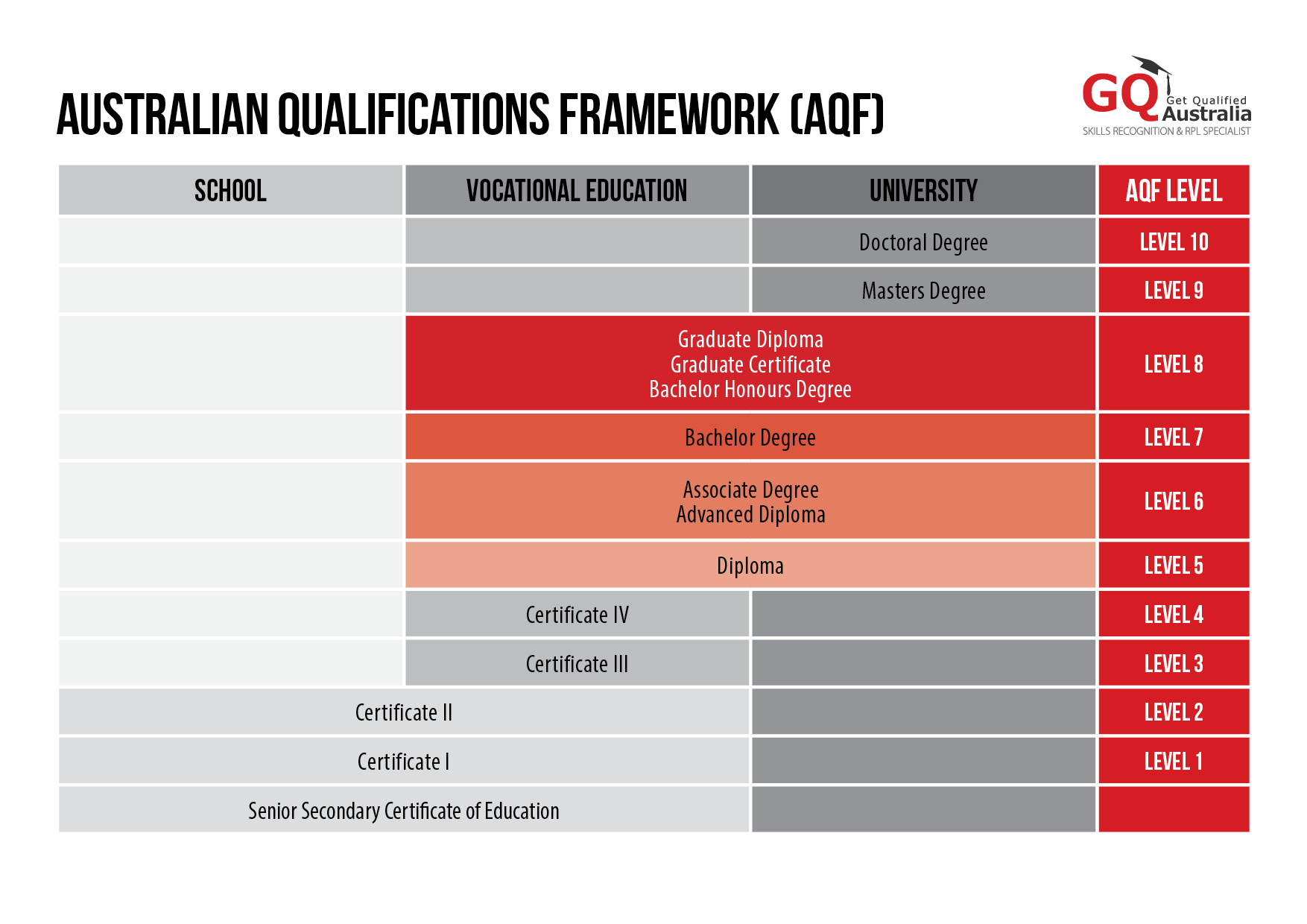
Get Qualified Australia’s University Pathways through the Australian Qualifications Framework (AQF)

AQF_Dial

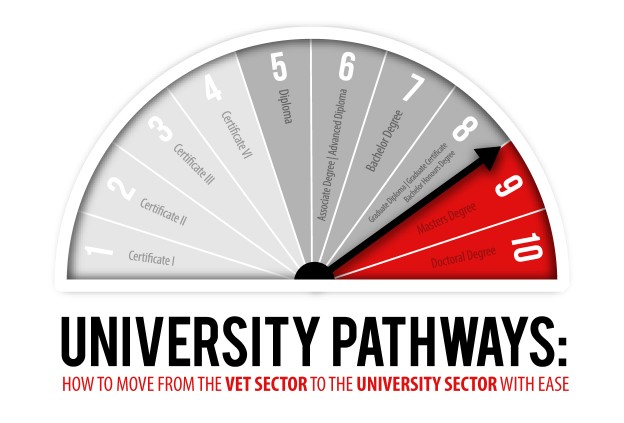
University Pathways: How to Move From the VET Sector to University

The road to educational attainment and accreditation never did run smoothly, however the once singular path has, in recent times, fragmented itself into multiple lanes, all travelling along a one-way highway toward the attainment of formal recognition and national accreditation.

Facilitating pathways to and through various formal qualifications, and providing a link between Vocational Education and Training (VET) and university sectors, the Australian Qualifications Framework (AQF) has made it possible for people to access university degrees through vocational qualifications.

Composed of various levels of educational achievement and the standards of those qualifications, the AQF removes boundaries between educational sectors, and merges them into a singular framework composed of national, quality-assured qualifications, and multiple cross-sector pathways.

AQF_Breakdown_V2

Skills Recognition & RPL has made it easier than ever for skilled and experienced candidates to move up the AQF structure without needing to engage in additional classroom study, take valuable time away from work, and learn what they already know.

In fact, converting one’s existing skills, knowledge and experience into a Nationally Recognised Qualification via Skills Recognition & RPL can help individuals attain nationally recognised VET qualifications that are aligned with the depth of their work and/or life experience, whilst also enabling a direct cross-over into university study.

These cross-over options are comprised of 3 primary pathways.

University Pathway Options

- Bachelor’s Degree Pathway
Attain a Diploma in your industry discipline and get an exemption of up to a 1 year from your Bachelor’s degree.

- Master’s Degree Pathway
Attain an Advanced or Graduate Diploma in your industry discipline and get an exemption of up to 1.5 years from your Master’s degree.

– Doctorate Pathway
Attain a Graduate Diploma in your industry discipline and get an exemption of up to 2 years from your Doctorate degree.

Whether you’ve got a Certificate IV and are looking to attain a Diploma, or have a Graduate Diploma and wish to apply for maximum credit exemption on either your Master or Doctorate degree, you can move up and through the various levels of the AQF with considerable ease through Skills Recognition. The road to educational attainment may not always run smoothly, but at least there is a direct path to getting there.

Think you have what it takes to make the leap? Schedule a free Skills Review Consultation with a Skills Recognition & RPL Specialist today, and see whether you’re eligible for your desired university pathway option.

MelbourneCup_V2

The Melbourne Cup: She’s Got Skills

Anything, and we do mean anything, can happen when you put your mind to it. Just ask Michelle Payne, the first female jockey to win the Melbourne Cup. In its 155 year history, Michelle has become the first and only female to put all of her talent, all of the horse’s best efforts, all of the trainer’s hard work, and all of the owner’s investment toward a first place finish at the race that stops a nation. Well, actually, two nations, if you count New Zealand.

Michelle not only had skills, but she also had a dream. She knew at an early age that she would win the Cup, making the announcement when she was just seven years old. After years of training, a terrible fall, a difficult recovery, a second fall, and more training, she overcame 100 to 1 odds in this rich, two-mile handicap race to take home the winner’s trophy.

While driven to succeed, Michelle didn’t get there on her own. She had help. Over the years, parents, trainers, owners, siblings, and friends all provided their support, putting their best effort forward to earn her the win. For this dream to happen, however, she still needed more. She needed a race to win.

Making the arrangements so that the Melbourne Cup race could take place required another, much larger team. One that knew how to groom the racecourse, decorate the field with 12,000 roses, arrange for the 100,000 guests to arrive, sit, and enjoy the events. It required a team to manage the fashion show and direct the television crews and photographers, while the horses, riders, trainers, and owners were properly housed and cared for. It required timers, officials, and judges to run the races, and a cast of thousands to see it all went smoothly. Teams like this are important in making big things happen, whether on the racecourse, in the office, or in the classroom. There’s still another important element, however, that was crucial to Michelle’s success.

Michelle had a dream. Think back to your early years, when all things still seemed possible. What was your dream? Did you achieve it? If not, are you still on track to get there? If you’re thinking that life has dealt you a different hand, steering you away from your dream, you might be surprised to learn of a way to put things back on track. It is called Recognition for Prior Learning, or RPL.

RPL considers workplace training, corporate training, and all types of learning, embracing formal, informal, and non-formal learning as valuable contributions to an academic award. If there is a certificate, qualification, or diploma that you’ve always dreamed of adding to your list of accomplishments, scheduling a free consultation to review your skills is the first step in the process. An RPL assessment will give you credit for the skills you’ve already mastered, allowing you to skip over introductory coursework and classroom study, gaining a head start on your dream.

Those mentors that taught you in your early career, that course you took in high school, that online program you made it through on your own, and that hobby you’ve pursued for years all count toward your experience, helping you to jump start the program that will achieve your dream. Through skills recognition, some programs may allow you to achieve your goal much sooner than you ever imagined, so dust off those dreams and let’s get started. Your odds are probably a bit better than 100 to 1, and look where that got Michelle.

Confirm whether your work experience can be converted into a qualification. Call Get Qualified Australia today on 133 775 to book in your free skills review consultation.

TradeRecognition

Can you achieve trade recognition through RPL?

One might think that achieving trade recognition through RPL sounds way too easy and good to actually be true, however, the facts speak for themselves – it’s very possible for Australian tradies to attain formal recognition using RPL, and they could be achieving it in weeks.

You might already be working in your industry. You’ve probably dedicated years or decades to your trade, are skilled in what you do, and do it for a living. However, despite your extensive experience and skill sets, you might not have the formal qualification to go with your expertise.

This is a common struggle for many skilled yet unqualified Australian workers – the knowledge that despite doing the work of a tradesperson, they aren’t formally recognised as such, having never completed an apprenticeship or acquired a qualification. Many in the industry consider them labourers who aren’t “real tradespeople”. Others simply accuse them of not “doing their time”.
However, this couldn’t be further from the truth. Having accumulated years (or even decades) of experience, they’ve dedicated just as much of their time, if not more so, than their qualified counterparts. Fortunately for them, there are options available for achieving formal recognition without the need for 3-5 years of classroom study, learning what they already know.

As the process through which skills and experience are assessed by a panel of industry and educational experts, ‘trade recognition’ allows workers who have skills and experience in a trade but have never completed an apprenticeship or gained a certificate, the opportunity to be awarded a trade-related certificate.

Instead of being a replacement for apprenticeships and training courses, however, skills or trade recognition merely provides another avenue for already skilled and experienced Australians to achieve formal recognition in a time and cost-effective way, acknowledging the extensive experience and service an individual has dedicated to their industry, without the need to spend tens of thousands of dollars studying.

While applications are considered on a case by case basis and eligibility requirements differ from qualification to qualification, the completion of a Certificate III in the related trade is usually the minimum requirement. This may be accomplished through Recognition or Prior Learning (RPL).

Introduced by the government in the 1990s, RPL has made is easier for Australians to achieve formal recognition through the issuing of Nationally Recognised Qualifications, bypassing unnecessary modes of study which aim to develop skills and knowledge that the candidate has already developed through experience.

Because these qualifications are usually issued from Certificate III and above, it is very possible for candidates to use these RPL-acquired qualifications to apply for formal trade recognition, especially when the qualification’s units verify that the candidate has proficiency in the required core and elective units.

You can find out more about attaining trade recognition through RPL here.

Think you have what it takes to achieve trade recognition through RPL?

Take our free skills review to see whether you’re eligible.

Looking to get licensed in your trade? Find your relevant state licensing body.